
But I don’t want to look like an idiot! A quick guide on TV interviews
Written by Phil Hayes, media trainer at Hayes Collins Media
When you go on TV news, you want to look professional, in control and not like an idiot.
So, as media trainers we often get asked what do I do practically when the reporter and the camera is in front of me? Do I look at the lens? Do I look at the reporter?
The glass cyclops
Any reporter worth their salt should be able to quickly explain that the only time you ever look at the lens is in a down-the-line interview, where you’re speaking to someone in a remote studio.
Looking at that horrible, unblinking glass cyclops can feel intimidating, but maintaining a steady eyeline with the lens helps you to make a connection with the audience at home, who feel like you’re looking at them.
Trust is found in the eyes and if the audience can see your eyes clearly, they’ll be able to determine that you’re telling the truth about your organisation and that you can be trusted.
Look at the reporter
You’ll get nothing back from that lens though, so when the reporter is there with you, always look at them.
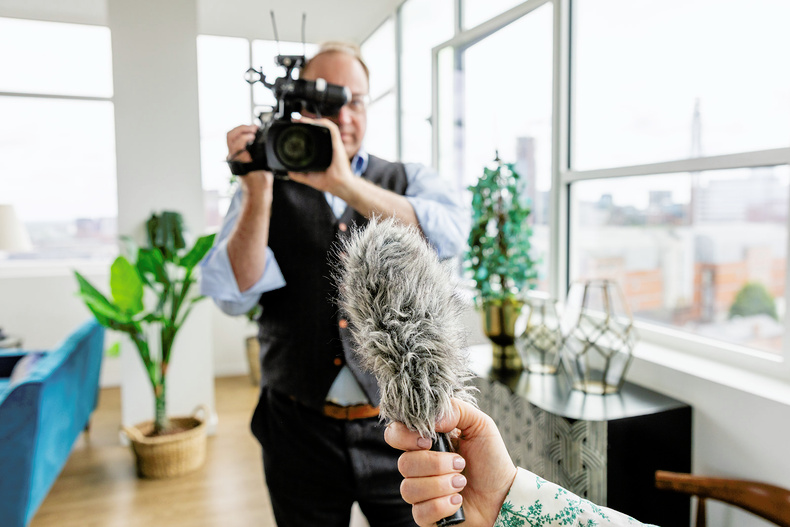
You’ll find it a lot easier to talk to a human being who is stood in front of you, probably nodding to show that they’re listening to you and moving the stick mic when it’s time for them to ask you the next question.
Nodding is fine for them, but don’t be tempted to do the same during a question. You may be an active listener – that’s great in meetings - but the nodding of listening looks identical to the nodding of “I agree with you” – not great if the question contains an accusation.
Don’t be shifty
Whatever you do though, don’t change your mind on eyeline part way through. There’s an understandable temptation to check that the camera is still there and glance at it for a moment.
Leave the camera to the reporter, it’s their job to make sure that all works. A little ‘side-eye’ to check on it will be picked up on tape and will make you look shifty, which isn’t the look we’re going for.
Who’s in charge of that microphone?
And, back on the stick microphone coming back and forth between you and the reporter for questions and answers, don’t be tempted to grab hold of it. That will likely make a noise – reporters are trained to handle mics silently – and will annoy the reporter stood in front of you.
It can feel intimidating when the mic is right under your nose, but in noisy environments, this is vital to get good quality sound.
Most times you will be interviewed with a stick mic, and that’s certainly the dominant model that we use for media training, with or without a ‘dead cat’* to keep the wind off the soundtrack.
*No animals were harmed, windshields are not made from cats, but film-makers just like to use that name.
Why radio mics are dangerous
On other occasions, probably in the studio, you’ll have a tie-clip mic clipped to you. These are usually wireless and are incredibly dangerous, because once you have one on you, you are bugged.
They work through walls, and at some distance, so no longer can you have a private chat with your press officer when you’re wearing one of these devices.
If you whisper to an advisor “I really hope they don’t ask me about what went wrong last week” you can guarantee that it will be picked up and you will be asked about last week. You’ll be letting them mark their own homework.
And we all remember Gordon Brown on the campaign trail, getting into a car and as he was being driven away, complaining about meeting “that bigoted woman”., words that were broadcast live in Sky News.
And, in the interests of political balance, I’ll mention another former Prime Minister, David Cameron , who was captured on a podium mic whistling a jaunty little tune after he’d been talking about the serious topic of Brexit in the street outside Number 10. Neither case made the subject look particularly clued up and soon became the story of the day.
Don’t let that happen to you.