
Fireside chat: The Lord Lieutenant visits YMCA Heart of England
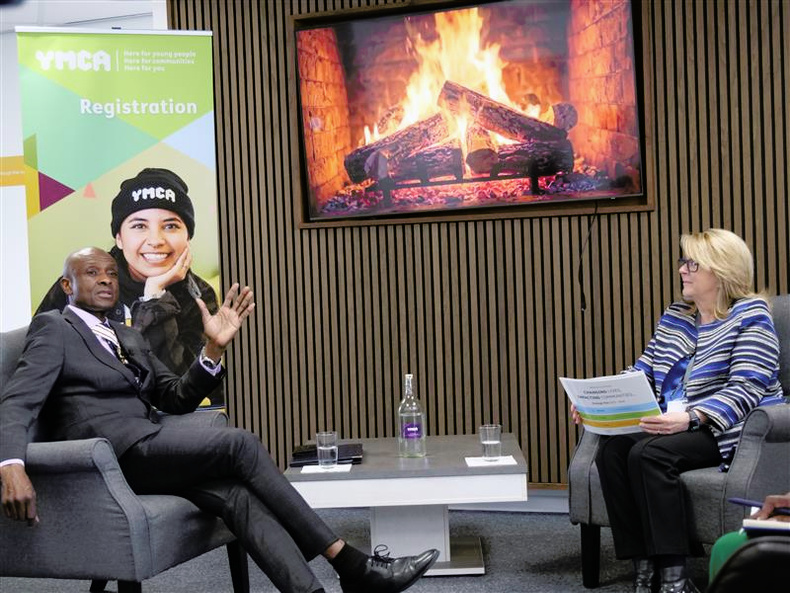
Written by M. Elena Roselli, Head of PR, Communications & Engagement at YMCA Heart of England
“I am Derrick first and foremost, call me anything else thereafter.”
There is something quietly powerful about humility in a person who has achieved so much.
When His Majesty’s Lord-Lieutenant of the West Midlands, Derrick Anderson CBE, visited YMCA Heart of England on Tuesday 24 February 2026, he did not arrive with ceremony at the forefront. Instead, he arrived as “Derrick first” — open, reflective and grounded.
In conversation with our Chair of the Board Dawn Ward CBE, and in the presence of our chief executive Pauline Tomlinson, staff and residents, the Lord-Lieutenant shared reflections on his life, values and service.
What unfolded was not simply a recounting of achievements, but a deeply personal discourse on resilience, identity and purpose — themes that resonate profoundly within the communities YMCA Heart of England serves.
Born in 1957 in London’s East End, during a period of social transition and tension, he grew up against the backdrop of post-war immigration debates and the global civil rights movement.
He spoke candidly about moments from his childhood that shaped his awareness of injustice at an early age.
A comment from a teacher — suggesting he should “go back” to Africa when he refused to eat Brussels sprouts — became an early reminder that identity and belonging were contested spaces. It was in these moments that resilience began to take root.
He reflected with pride on his lineage, describing a long line of strong Maroon women on his mother’s side — women who had escaped slavery and, in some cases, bought their own freedom.
The surname “Freeman,” he noted, carried both history and strength. “Fierce women are in my genes,” he said. That heritage, coupled with economic hardship, meant he was “forced into adulthood” earlier than most, learning responsibility before he had learned how to play.
Yet even in challenge, he found inspiration. Comic books became unexpected mentors. Marvel heroes resonated not for their superpowers, but for their struggles and resilience in overcoming them.
The Black Panther was significant because “he looked like me.” The Daredevil inspired him because he was an ordinary man who honed his skills to become exceptional. The message he carried forward was simple yet profound: “You can be ordinary and exceptional at the same time.”
This belief in steady self-improvement continues to guide him. When asked about what helps him stay motivated, he shared that he does not compete, gamble or measure himself against others. Instead, he focuses inward — on becoming better than he was yesterday. His personal philosophy is captured in the acronym FRESH:
- Fair – to be just in every interaction with other people and himself
- Respect – to be respectful of people and their history
- Excellence — first for oneself, always asking, “Am I helping? Am I doing my best?”
- Service — rooted in the Maroon tradition of collective survival
- Honesty — especially honesty with oneself
For those working in the voluntary and support sector, these principles felt particularly resonant.
Service, not status. To serve, not be served. Contribution, not recognition. “Not what we can take, but what we can give,” he reflected — a sentiment that mirrors the daily work of YMCA Heart of England across Birmingham, Coventry and Warwickshire.
In speaking about his role as Lord-Lieutenant, he described it not as a departure from his life’s work, but as an extension of it.
While the office carries legal and ceremonial responsibilities, at its heart lies service and community connection. “If someone brings up a problem, I know someone that knows someone that can help,” he explained — illustrating the role as a bridge between people, institutions and opportunity.
His appointment to the Lieutenancy itself was characteristically understated. Only a few years ago, he admitted, he had little awareness of what the role entailed. It was only when working with John Crabtree on the Board of the Commonwealth games that he came across the position for the first time.
When asked to suggest names during the consultation to select the new Lord-Lieutenant, he did not include his own. Yet others had put him forward. From his career he had learned never to dismiss a head-hunter outright — “you never know what could come from it.”
He received confirmation of his appointment while volunteering in Mozambique on micro-enterprise projects designed to create sustainable opportunity for local communities.
Throughout the conversation, he returned repeatedly to the idea of purpose.
Purpose, he suggested during a Q&A with YMCA Heart of England’s youth ambassador, who was asking about the struggle of maintaining motivation when forced to be resilient, is not always about enjoyment. It is about vision and direction. “I am not, and probably will never be, the finished product,” he said. Growth is ongoing. Failure is inevitable. The real question is whether we learn when things go wrong.
For residents and staff alike, particularly those navigating uncertainty or rebuilding stability, his words carried weight. Purpose is not imposed; it is discovered. Institutions, he suggested, must create environments where passion can be ignited and supported.
When reflecting on balancing tradition with modern community needs, he spoke pragmatically about evidence, context and risk. Decisions, he emphasised, must be informed and realistic.
Change, he noted, often follows a familiar pattern: a small proportion of people readily embrace it, another set resists it, and the majority sit somewhere in between. The task of leadership is not to fight the resistant minority, but to engage the persuadable majority with reassurance and clarity.
Music, too, featured in the conversation with the captivated audience. For him, it represents communication and community — echoing the Maroon tradition where music carried messages of survival and solidarity. A trained dancer in earlier years, he sees music as a connector of people and purpose.
On the subject of racism, he spoke with calm conviction. Strength, he suggested, is not only about confrontation but about judgement — knowing when and how to act. Leaders, he stressed, must model integrity and keep doors open to change. “If you can’t change the people, change the people,” he remarked — a reminder that sometimes progress requires new voices and new spaces.
By the close of the afternoon, what lingered was a sense of humanity. The Lord-Lieutenant’s closing reflections were not about title or prestige, but about effort: wanting to know, when the time comes for him to go, that he has tried his best.
For an organisation such as YMCA Heart of England — dedicated to supporting young people and communities through challenging times — the significance of this message cannot be overstated. Service grounded in fairness, respect and honesty. Leadership rooted in hands-on experience. Humility as a strength in striving for excellence. Resilience shaped by purpose.
“I am Derrick first,” the Lord-Lieutenant said.
And in that statement lay the heart of this fireside conversation: a reminder that true leadership begins with humble humanity.