
Five catastrophic and common mistakes in UK Spouse Visa applications
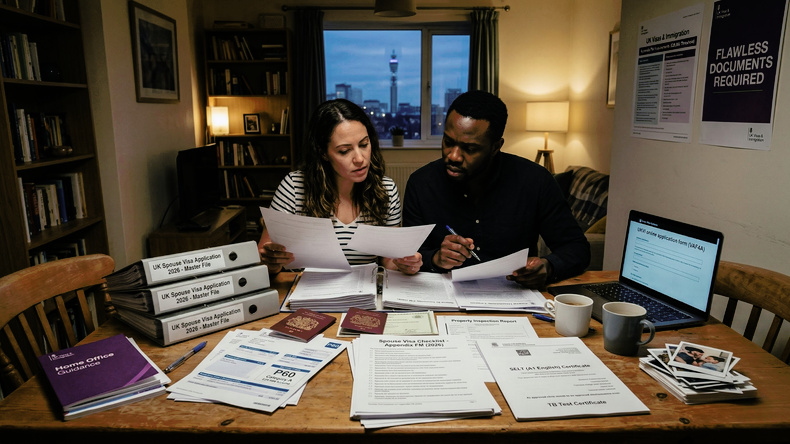
Written by D&A Solicitors
The UK Home Office is not known for its warm hospitality or its forgiving nature.
For couples dreaming of building a life together in the United Kingdom, the spouse visa application process often feels less like a standard legal procedure and more like an endurance test designed by a sadist.
In 2026, the stakes remain incredibly high. A single misplaced document, a miscalculated payslip, or an expired certificate can result in a swift and uncompromising refusal.
For the applicant, this means lost application fees running into the thousands, devastating delays, and the grim prospect of starting the whole miserable process from scratch.
As solicitors, we see the aftermath of DIY visa applications gone wrong every single week. People often assume that because their relationship is genuine, the Home Office will simply see sense and take their word for it.
Unfortunately, caseworkers do not deal in romance or common sense; they operate on cold, hard, heavily mandated evidence. The Home Office does not possess a heart; it possesses a checklist, and they are actively looking for reasons to say no.
In this comprehensive guide, we are breaking down the five most catastrophic, yet entirely common, mistakes made in UK spouse visa applications today. By understanding these pitfalls, you can ensure your application is practically bulletproof before you click submit.
Mistake 1: Botching the minimum income requirement
The financial requirement is the undisputed graveyard of UK spouse visa applications. If you get the maths wrong here, your application will be rejected before the caseworker has even looked at your wedding photos.
Following the controversial changes implemented in Spring 2024, the minimum income requirement for sponsoring a partner remains set at £29,000 per annum for 2026.
While the previous government had threatened to push this figure as high as £38,700, further increases have currently been paused pending review.
However, £29,000 is still a significant hurdle, and the strict rules governing how you prove this income are where most applicants stumble.
The danger of category confusion
The Home Office categorises income into specific brackets, primarily Category A (with the same employer for six months or more) and Category B (less than six months, or variable income).
A frequent and fatal error is applying under Category A when you actually fall into Category B. If you have been with your employer for five and a half months when you apply, you do not meet Category A. The Home Office will not round up.
The exactness of the evidence
If you are relying on salaried employment, you must provide exactly six months of payslips and exactly six months of bank statements showing that salary being deposited.
The catastrophic mistake here is a discrepancy between the two. If your payslip says you earned £2,416.66 after tax, but your bank statement shows a deposit of £2,416.00 because your employer rounded it down, that 66-pence difference can trigger a refusal if left unexplained. The paper trail must be flawless.
The cash savings trap
Applicants are permitted to use cash savings to meet the financial requirement, either entirely or to top up a salary shortfall. However, the calculation is brutal. To rely solely on savings in 2026, you do not just need £29,000 in the bank. You need to cover the entire £29,000 for the two-and-a-half-year duration of the visa, plus a base figure of £16,000.
The calculation is: (£29,000 x 2.5) + £16,000.
Therefore, you must show a staggering £88,500 in cash savings.
Furthermore, these funds must have been sitting in an accessible bank account, in your name or your partner's name, untouched for exactly six months prior to the date of application. Dipping into that account and dropping the balance to £88,499 for a single day during that six-month period will invalidate your financial proof.
Mistake 2: The "War and Peace" approach to relationship evidence
The Home Office requires proof that your relationship is "genuine and subsisting". In an attempt to prove this beyond a shadow of a doubt, many unrepresented applicants adopt a scattergun approach, effectively dumping a chaotic digital footprint onto the caseworker's desk.
We frequently see applicants submitting 500 pages of unindexed WhatsApp messages, thousands of blurry selfies, and endless call logs. This is a profound misunderstanding of how the system works.
Caseworkers are under immense time pressure; they are not going to read a novel's worth of late-night text messages about what you want for dinner.
If they cannot quickly decipher the timeline of your relationship, they will simply refuse the application citing insufficient structured evidence.
Curation over quantity
A successful spouse visa application is highly curated. Think of it like optimising a website for a search engine: the information must be structured, easily navigable, and directly answer the core requirements without unnecessary bloat.
Strong evidence of cohabitation and shared financial responsibility always trumps social media screenshots. The hierarchy of relationship evidence is clear:
- Top Tier (Strong): Joint tenancy agreements, joint mortgage statements, council tax bills in both names, and joint utility bills.
- Middle Tier (Acceptable): Bank statements in separate names registered to the same address, official correspondence from government bodies (like HMRC or the DVLA).
- Bottom Tier (Weak on its own): Photographs, flight tickets, and chat logs.
The digital breadcrumb trail
If you have lived apart, communication logs are necessary, but they must be presented logically. A curated selection of messages spanning the duration of your separation—perhaps one or two screenshots per month—is entirely sufficient.
These should be compiled into a single, clearly labelled PDF document. Providing a coherent narrative is far more effective than burying the caseworker in unstructured data.
Mistake 3: Fumbling the English language and Tuberculosis certificates
It is astonishing how often a perfectly valid, genuine marriage is disregarded because the applicant took the wrong English test or let a certificate expire.
The Home Office leaves zero room for error regarding health and language requirements.
The Secure English Language Test (SELT) pitfall
Unless the applicant is from a majority English-speaking country or holds a degree taught in English (which requires its own verification through Ecctis), they must pass an approved English language test.
For an initial spouse visa entry clearance, the requirement is CEFR Level A1 in speaking and listening. For a visa extension, it rises to A2.
The fatal error applicants make is booking a generic English test at a local college. The Home Office only accepts results from specific Secure English Language Test (SELT) providers, such as Trinity College London, LanguageCert, or IELTS SELT Consortium.
If you submit a certificate from an unapproved provider, it does not matter if you speak the language better than the King; your application will be refused.
Furthermore, these certificates have a shelf life. They are generally only valid for two years. Submitting an expired certificate is a guaranteed rejection.
The Tuberculosis (TB) testing oversight
If the applicant is residing in a country on the Home Office's TB testing list, they must provide a valid TB test certificate. Much like the English language requirement, this test cannot be done by your local family doctor. It must be conducted at a clinic explicitly approved by the UK Home Office.
We have seen applications fail simply because an applicant went to an unapproved clinic in their home city to save themselves a three-hour drive to the approved facility. The bureaucracy is unforgiving.
Mistake 4: The accommodation oversight
Where are you going to live? It seems like a simple question, but the legal definition of "adequate accommodation" is a frequent stumbling block.
The Home Office requires proof that the couple (and any dependents) will have adequate accommodation in the UK that they own or occupy exclusively, without recourse to public funds, and crucially, without overcrowding.
"We'll just crash in the spare room"
Many younger applicants, or those trying to save money, plan to live with the British sponsor's parents. This is entirely permissible, but simply stating "we will live with my parents" is a fast track to a refusal.
To satisfy the caseworker, you must provide a rigorously documented paper trail. This includes:
- A formal letter of consent from the parents (the property owners) confirming you have permission to reside there.
- Proof of the parents' ownership (such as the Title Register from the Land Registry or a recent mortgage statement).
- A Property inspection report.
The Property Inspection Report is where many applications fail.
This is a formal report carried out by an independent environmental health officer or a qualified surveyor. It assesses the number of rooms in the house, the current number of occupants, and explicitly confirms that adding the visa applicant will not breach the UK's statutory overcrowding regulations under the Housing Act 1985.
Ignoring this requirement is a catastrophic oversight.
The rented accommodation trap
If the sponsor is renting privately, providing the tenancy agreement is not always enough. If the visa applicant's name is not on the lease, you must obtain a formal letter from the landlord or letting agent explicitly granting permission for the applicant to move in.
Landlords can be notoriously slow to provide these, and submitting the application while you "wait for the letter to arrive" will result in a refusal. The evidence must be locked in before the application is submitted.
Mistake 5: Digital disorganisation and uncertified translations
We live in a digital age, and the Home Office has entirely digitised the application process. You no longer post massive bundles of physical paperwork to Sheffield; everything is uploaded via a web portal. However, this digitisation has introduced a new breed of catastrophic errors.
The chaotic upload
A poorly organised digital upload is the equivalent of dropping a box of loose, unnumbered papers onto a judge's desk and expecting them to sort it out.
Caseworkers will not spend their day rotating upside-down PDFs or trying to decipher files simply named Document_1.jpeg and image(4).png.
If your documents are not logically grouped, clearly labelled, and easy to read, the caseworker may simply conclude that the required evidence has not been provided.
Tech-savvy applicants understand that user experience matters. Group your financial evidence into one clearly named PDF (e.g., Sponsor_Bank_Statements_Jan_to_Jun_2026.pdf). Group your accommodation evidence into another. Make the caseworker's job as frictionless as possible.
The uncertified translation error
If any piece of evidence—be it a marriage certificate, a bank statement, or a message log—is not in English or Welsh, it must be accompanied by a certified translation.
A common, money-saving mistake is having a bilingual friend translate the document, or relying on software. The Home Office rules are absolute: the translation must be fully certified by a professional translator.
The document must include the translator's credentials, contact details, signature, the date, and a formal declaration that it is an accurate translation of the original document.
Providing an uncertified translation of a foreign marriage certificate essentially means, in the eyes of the Home Office, that you have not provided a marriage certificate at all.
Summary: The cost of getting it wrong
The current Home Office application fee for a spouse visa is steep, and when you add the mandatory Immigration Health Surcharge (IHS) of £1,035 per year, the upfront costs are immense. A refusal does not result in a refund of your application fee.
More importantly, a refusal adds a permanent black mark to your immigration history. While you can appeal certain decisions on human rights grounds, the appeals process is notoriously sluggish, often taking up to a year to reach a tribunal. That is a year of forced separation, mounting legal costs, and intense emotional strain.
The most common thread connecting all these catastrophic mistakes is the belief that common sense will prevail. In UK immigration law, common sense is irrelevant; only strict adherence to the Immigration Rules matters.
Frequently asked questions
How long does a UK Spouse Visa take to process in 2026?
Standard processing times for out-of-country applications hover around the 12 to 24-week mark, depending on current Home Office backlogs.
Priority services are sometimes available for an additional fee, reducing the wait to around 30 working days, though this is never guaranteed.
Can I use my partner's income if they live abroad with me?
Generally, no. If you are applying under Category A or B through employment, the Home Office looks at the British sponsor's income.
The foreign applicant's income can only be counted if they are already inside the UK legally, working on a visa that permits employment (such as a Skilled Worker Visa or a Youth Mobility Scheme visa).
What happens if I forget to declare a minor criminal conviction?
Total disaster. The Home Office cross-references applications with international databases. Failing to declare an old or "minor" conviction will be viewed as deception.
An application refused on the grounds of deception will severely damage any future attempts to enter the UK. Always declare everything.
Do we need an immigration lawyer to apply?
There is no legal requirement to use a solicitor. However, given the complexity of Appendix FM of the Immigration Rules, the high financial threshold, and the dire consequences of a refusal, navigating this labyrinth alone is a massive risk.
A specialist solicitor acts as quality control, ensuring your application meets every exact parameter before it reaches the Home Office.
How D&A Solicitors can help
At D&A Solicitors, we understand the profound anxiety that comes with submitting a family visa application. We specialise in taking the burden of bureaucracy off your shoulders.
Our immigration team does not just fill in forms; we forensically audit your financial records, meticulously structure your digital evidence, and ensure that every single document aligns perfectly with the Home Office's strict 2026 guidelines. We build applications designed to pass the most rigorous caseworker scrutiny.
If you are planning to apply for a UK Spouse Visa, or if you need assistance challenging a recent refusal, contact our team today for a consultation. Let us ensure your application is right the first time.