Full Fibre Now Available Across Birmingham (Even If You've Been Told No)
Why Birmingham businesses keep hearing “full fibre isn’t available”
If you run a business in Birmingham, you’ve probably heard the same line more than once: “full fibre isn’t available at your address”.
For many firms, it’s become a brick wall. Comparison sites say no, big national providers recommend an expensive leased line, or you’re told to sit tight and wait for a future build phase.
Behind the scenes, there’s a very simple reason. Large residential-focused providers design their networks to pass as many homes as possible. Busy commercial streets, older buildings, multi-tenant offices and industrial estates are often left on ageing copper or basic FTTC, even though those are the very places that need reliable business broadband the most.
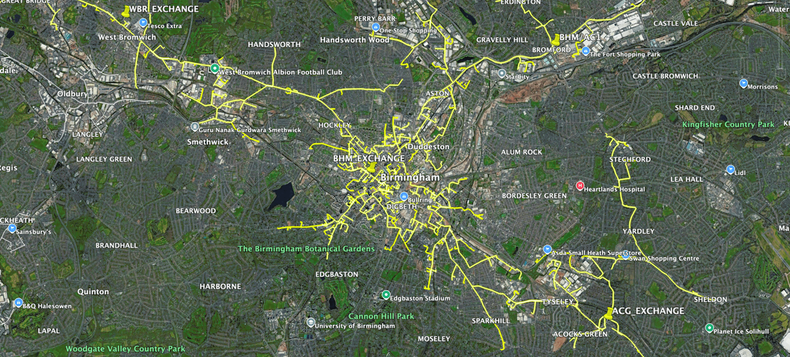
At the same time, a new wave of alternative full fibre networks has been quietly building across Birmingham and many of them don’t sell direct to end customers. They build the infrastructure and use approved partners like us to connect businesses. The result? Public availability checkers often show “not available” when, in reality, there’s a perfectly good full fibre route waiting to be used.
At Power Fibre, this is the problem we solve every day for Birmingham SMEs.
Why online availability checkers often get it wrong
When a postcode search says “no”, it’s easy to assume that’s the end of the story. In practice, it usually just means the checker has incomplete information.
Some of the reasons we see again and again:
1. Partner-only fibre networks
A number of high-quality fibre carriers in Birmingham only sell via partners. They don’t appear on comparison sites or big-brand checkers. They focus on planning and building, and rely on approved partners like Power Fibre to handle quoting, surveys and installation for business broadband and full fibre.
2. Databases that haven’t caught up
Public checkers are not always in sync with live build plans. New fibre spines go in, capacity changes, splitters are upgraded, but those changes can take months to be reflected online.
3. Commercial buildings and MDUs
Multi-floor offices, converted properties and multi-dwelling units regularly confuse automated lookups. A checker might see one copper line and assume that’s the only option, even when fibre is already in the building or on the same block.
4. Wayleaves and routes never progressed
If no one has pushed for landlord permission, alternative entry routes or updated ducting, the system will often default to “not available”. That doesn’t mean it’s impossible, it just means no one has done the legwork yet.
5. Capacity quirks
Local fibre splitters fill and free up over time. If you only ever run the same automated check, you’ll never see those subtle changes. A manual re-check against multiple carriers can reveal new options.
Our job is to go beyond the generic checker, cross-reference multiple networks, talk to real build teams and visit sites where needed. That’s how “no” often turns into “yes”.
Where we’re getting Birmingham businesses connected
Because we’re based in Birmingham, we see these patterns up close. Some of the hotspots where we’ve helped turn “not available” into “installed” include:
Jewellery Quarter & Hockley - Studios, workshops, small manufacturers and creative spaces in heritage buildings that were never prioritised by residential fibre rollouts.
City Centre & Colmore Row / Snow Hill / New Street - Multi-floor offices and co-working spaces where fibre exists nearby or in the building, but doesn’t show online.
Edgbaston - Clinics, consulting rooms and professional services along key routes that still rely on copper-based products.
Aston & Nechells - Industrial units and small warehouses that need stable uploads for CCTV, cloud backups and remote access.
Digbeth & Deritend - Event venues, production spaces and creative hubs in older fabric, where there are often workable duct routes if someone is willing to investigate.
Lichfield Road corridor and surrounding areas - Trade counters, light industrial and roadside retail where access options are steadily improving.
If you’re in or around these areas and your business broadband checks have drawn a blank, it’s always worth a second opinion.
FTTP vs Leased Line – which is right for your business?
For most Birmingham SMEs, the decision now comes down to Full Fibre (FTTP) or a Leased Line. Both are fibre; they just serve different needs.
FTTP - Full Fibre to the Premises
- Fibre all the way into your building
- Symmetrical speeds typically from 100Mbps up to 1–5Gbps
- Ideal for VoIP, Teams/Zoom, VPNs, point-of-sale, cloud apps and everyday office use
- Significantly more reliable and futureproof than copper-based ADSL or FTTC
- For the majority of small and medium businesses, FTTP is now the natural starting point
Leased Line
- A dedicated, uncontended circuit just for your organisation
- Symmetrical speeds from 100Mbps to 10Gbps+
- Backed by business-grade SLAs and rapid fault response
- Best suited to contact centres, multi-site operations, large uploads, or workloads where downtime is simply not an option
- Our view is straightforward: start with what your workload actually needs, not just the biggest headline speed. Many businesses find that a well-specified FTTP connection comfortably supports their day-to-day operations. Where uptime and guaranteed performance are mission-critical, a leased line becomes the logical next step.
The BT copper switch-off: why this matters now
Layered on top of all this is the national BT PSTN/ISDN switch-off. The UK’s analogue phone network is being retired, with final shutdown scheduled by 31 January 2027, and milestones leading up to it. Copper-based phone services are being withdrawn, and calls are moving fully to IP.
For broadband, that means older copper-based products such as ADSL and many FTTC variants are being phased out. Openreach has already put “stop-sell” policies in place across a growing list of exchanges, limiting changes on legacy services and nudging businesses towards full fibre (FTTP) or leased lines.
In practical terms, if you’re still relying on broadband delivered over old-style phone lines, you’ll find:
- Fewer changes and upgrades are allowed
- Availability starts to shrink
- Support focuses increasingly on full fibre alternatives
Planning your move now, rather than in a last-minute rush, gives you time to think about number porting, VoIP setup, router configuration and future growth.
How we work with Birmingham businesses
Our approach is simple and hands-on. We act as a local connectivity partner, not just another anonymous supplier.
A typical engagement looks like this:
1. Initial review
We take your address, current setup, number of staff and critical systems (phones, tills, cloud apps, remote sites) and get a clear picture of how you work.
2. Multi-network checks
We run manual checks across several full fibre and leased line carriers, including those that don’t appear on comparison sites and speak to build teams where needed.
3. Survey and route planning
For more complex premises, we arrange an on-site visit to look at risers, duct routes, comms rooms and potential entry points.
4. Landlord and agent liaison
Where wayleaves or method statements are required, we help handle the conversation so things keep moving.
5. Proposal and schedule
You get a clear, plain-English proposal: recommended access type (FTTP or leased line), speeds, term, costs and realistic timescales.
6. Install and cutover
We don’t just get fibre to your door; we ensure a clean run to your comms rack, configure the router, and test key services, especially VoIP and any line-of-business applications.
7. Aftercare and growth
Because we’re based in Birmingham, you’re dealing with a local team who can support you as you add users, phones or sites, rather than starting from scratch every time.
Why full fibre pays back quickly
Moving to full fibre broadband is not just a technical upgrade; it has day-to-day business benefits:
- Clearer calls: VoIP and Teams meetings become more stable, even at busy times.
- Fewer interruptions: Staff spend less time saying “the internet’s slow again”.
- Faster workflows: Backups, large file transfers and SaaS systems stop bottlenecking.
- Room to grow: You can add staff, phones and cloud tools without constantly rethinking your connection.
For many firms, the gains in productivity and reduced hassle quickly outweigh the difference in monthly cost compared with older copper-based services.
Ready to get a straight answer on full fibre?
If your business is in the Jewellery Quarter, Hockley, City Centre, Colmore Row, Snow Hill, New Street, Edgbaston, Aston, Nechells, Digbeth, Deritend, along the Lichfield Road corridor or nearby, and you’ve been told full fibre isn’t available, we’re happy to check.
We work across multiple networks and commercial build teams, so we often find viable options where standard checkers and big providers have said no. And you don’t have to take our word for it, our Google Reviews reflect the work we’ve already done for Birmingham organisations in exactly this position.
Send us your postcode and a note about how you use your connection. We’ll give you an honest view of what’s possible and a clear plan to move from “not available” to installed and working.