
Good job vs High wage job: What should really matter in your career?
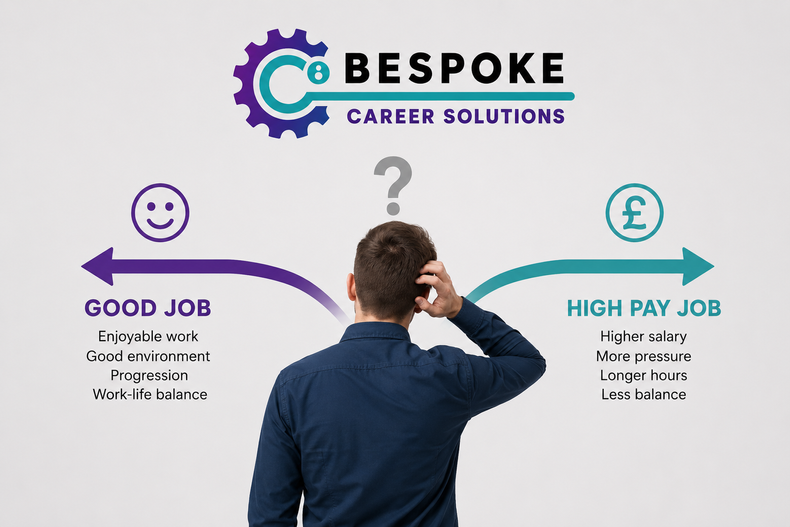
There is nothing wrong with wanting a better wage.
Let’s be honest, pay matters. It matters when the mortgage or rent is due. It matters when food, fuel, childcare and bills all seem to go up at the same time. It matters when you are working hard, turning up every day, doing skilled work and expecting to be paid properly for it.
At Bespoke Career Solutions, we would never tell a candidate that money is not important. It is. A good rate of pay can change your standard of living, give you more breathing space and make work feel more worthwhile.
But after many years in recruitment, you start to notice something.
The highest-paid job is not always the job people stay in.
Some candidates move for more money and it works out brilliantly. They feel valued, they earn more, they progress and it gives them the step up they needed.
Others move for the wage and quickly realise they have walked into the wrong environment. Longer travel, poor management, a shift pattern that drains them, no support, no progression, or work they simply do not enjoy.
That is when the question becomes bigger than pay.
Are you earning more, or are you actually better off?
A higher wage can be the right move
There are times when moving for more money makes complete sense.
If you are experienced, reliable and skilled, you should be paid fairly. Whether you are a welder, fabricator, FLT driver, machine operator, engineer, administrator, accounts professional or warehouse worker, your experience has value.
If your current role has not kept up with your ability, a higher-paid job can be the right step. It can give you more security, more respect and a better quality of life.
For some people, money is the main driver at a certain point in life. That might be because of family commitments, buying a house, saving, paying debts, supporting children or simply wanting more comfort.
The problem starts when salary becomes the only thing you look at.
The job with the best rate is not always the best job
I have seen candidates turn down steady, decent roles because another job offered slightly more per hour. On paper, it looked like the obvious choice.
Then the details came out.
The higher-paid role meant another 40 minutes each way in traffic. The overtime was not guaranteed. The team had a high turnover. The training was rushed. The shift pattern made family life harder. The company expected more but did not offer much support.
That extra money suddenly looked smaller.
This is where candidates need to slow down and look at the full picture. A rate of pay is only one part of the job. It does not tell you what the manager is like. It does not tell you whether the team gets on. It does not tell you whether the company invests in people or just replaces them when they leave.
A high wage can be attractive, but it will not fix a bad working environment.
What actually makes a job a good job?
A good job is not the same for everyone.
For one person, it might be steady Monday to Friday work with no weekends. For someone else, it might be overtime, shift allowance and the chance to earn as much as possible. Another person may care more about progression, training or getting into a better company long term.
A good job usually comes down to a mix of things:
Pay, yes.
But also the type of work, the people around you, the way you are treated, how far you travel, whether the hours suit your life, whether you can see a future there and whether you feel respected.
Some people are motivated by money. Some are motivated by position. Some want to learn. Some want stability. Some want to work with good people and go home without stress following them through the door. None of those reasons are wrong.
The important thing is knowing what genuinely matters to you before you make a move.
Do you actually like the work?
This is one of the biggest questions candidates forget to ask themselves.
Not “can I do the job?”
Not “is the money better?”
But: do I actually want to do this every day?
You might be good at welding, but prefer lighter fabrication to heavy structural work. You might have warehouse experience, but hate picking targets and prefer FLT work. You might be strong in accounts, but want more responsibility than basic admin. You might be good on machines, but want to move into setting, programming or maintenance. Being capable of doing a job is not the same as enjoying it.
When someone enjoys the work, you can usually tell. They take more pride in it. They ask better questions. They settle quicker. They build better relationships. They are more likely to stay and progress.
When someone dislikes the work, the wage can keep them there for a while, but rarely forever.
Colleagues and managers matter more than people admit
People often say they are leaving for money, but when you talk properly, the real reason is usually deeper. They do not feel listened to. They do not trust the manager. The atmosphere has changed. They are tired of broken promises. They feel stuck. They are working with people who make the day harder than it needs to be.
A good team can make difficult work feel manageable. A poor team can make an easy job feel unbearable.
That is why candidates should pay attention during the recruitment process. How does the company communicate? Are they clear about the role? Do they explain the hours, expectations and training properly? Do they seem organised? Do they treat the interview as a two-way conversation?
If everything feels rushed, vague or disorganised before you start, it may not improve once you are there.
Progression can be worth more than the starting wage
This is where career decisions get tricky.
Sometimes the job with the lower starting wage is the better long-term move.
That does not mean candidates should undersell themselves. It means you should look at where the role could take you.
A job that teaches you new machinery, gives you recognised training, moves you into a skilled area or opens a route into supervision could be worth more over time than a job paying slightly more with no development.
We see this a lot in manufacturing, engineering and technical roles. One extra skill can change someone’s earning potential. Learning to read drawings properly, set machines, operate different equipment, lead a small team or understand quality processes can move a candidate forward.
Sometimes the question should not be “what does this pay today?”
It should be “where could this put me in 12 months?”
What leads to bad career decisions?
Most bad career decisions are not made because people are careless. They are usually made under pressure.
Someone has had a bad week at work and wants out quickly.
Someone sees a higher rate and jumps without asking enough questions.
Someone takes a job because the title sounds better.
Someone listens to a friend who says a company is great, but forgets that people want different things from work.
Someone stays in a role far too long because change feels risky.
These are all normal reactions. Work is personal. When you spend that many hours somewhere, it affects your mood, confidence and home life.
But decisions made in frustration can be expensive. Before accepting or rejecting a role, it is worth stepping back and asking:
Will this job improve my life, or just my wage?
Will I enjoy the work?
Can I get there easily every day?
Will the hours work for me?
Is there a future in it?
Do I trust what I have been told?
Would I still want this job if the wage was the same as my current role?
That last question is useful. It cuts through the noise.
What should candidates look for in a career?
A good career is not always a straight line. People change direction. Priorities shift. What mattered at 25 may not matter at 45. Family life, health, confidence, money, ambition and lifestyle all play a part.
The best career choices usually balance five things:
Fair pay
You should be paid properly for your skills, time and reliability.
Work you can live with
You do not have to love every minute, but the work should suit you enough to do it well.
A decent environment
Good people, clear expectations and fair treatment make a huge difference.
Room to improve
Progression does not always mean management. It can mean better skills, better confidence and better options.
A life outside work
A job should support your life, not completely take it over.
A good job and a good wage can go together
This is the point people sometimes miss. It does not have to be one or the other.
You should not have to choose between being paid fairly and being happy at work. The best roles are usually the ones where candidates feel valued in more than one way. They are paid properly, treated fairly, given clear expectations and able to see some kind of future.
That is what good recruitment should help with.
At Bespoke Career Solutions, we are not just interested in filling vacancies quickly. We want to understand what candidates are looking for, what they are good at and what type of role is likely to suit them. That means asking better questions and being honest about the opportunities available.
Because a job is not just a wage slip.
It is your routine, your confidence, your lifestyle, your progress and a big part of your week.
So yes, look at the money. It matters.
But also look at the work, the people, the hours, the environment and the future.
The right job should pay fairly, but it should also feel like a move in the right direction.
Looking for your next opportunity?
Bespoke Career Solutions supports candidates across manufacturing, engineering, logistics, industrial and commercial sectors throughout the West Midlands, Staffordshire and across the UK.
Visit www.BespokeCareerSolutions.com or contact our team to discuss current opportunities.
Richard Bourne
Bespoke Career Solutions