
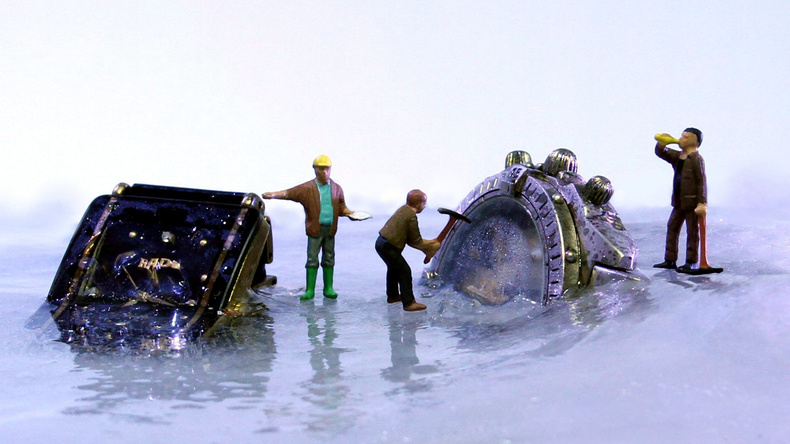
Is your brand frozen in time?
Written by Ghost
Visit enough SME websites and you start to notice the same phrases appearing time and again on the About Us page: Established in 1998, Family run since 1987, Over 35 years of experience.
There is nothing wrong with any of those statements. In fact, longevity is something many businesses should be proud of. Building, sustaining and growing a company over many years takes resilience, consistency and hard work.
But for many established businesses, there comes a point when a more important question needs to be asked:
Does your brand still reflect the business you are today, or the business you were when you first started out?
Quite often, the answer is the latter.
When business moves on, but the brand stands still
In the early stages of a business, the priority is usually to get moving. A logo is created, a website goes live and some basic messaging is written to help the company enter the market. At that point, the brand does its job, but the challenge comes later.
Ten, twenty or thirty years on, many businesses have changed significantly.
They may have grown their team, expanded their services, built a stronger reputation, moved into new markets or developed a much clearer understanding of what sets them apart. Basically put, the business has evolved, but the brand has not always kept pace.
As a result, the website and messaging can end up presenting an older version of the company; one that no longer fully reflects its capability, confidence or ambition.
The problem with familiar language
Ghost sometimes refer to this as Bad Brand Bingo: the collection of phrases that appear on countless business websites because they feel safe, familiar and credible. Phrases such as:
- Established in…
- The best solutions
- A partner you can trust
- Quality service
- A one-stop shop
The issue is not that these phrases are wrong. The issue is that they are so widely used that they no longer say very much.
When every business describes itself as trusted, experienced and customer-focused, it becomes much harder for potential clients to understand what genuinely makes one business different from another.
This is often where a brand starts to feel dated. Not because the company lacks relevance, but because the language has become too generic to communicate its true value.
Experience is valuable, but only when it means something
A long trading history can be a real strength. In many sectors, it helps to build trust and reassure customers that a business has depth, knowledge and staying power.
However, experience on its own is rarely enough. What matters just as much is what that experience has enabled the business to become. That is why history works best when it supports the story, rather than trying to be the story on its own. For example, there is a difference between saying:
Established in …
and saying:
For nearly 30 years, we have helped manufacturers solve complex engineering challenges.
Both communicate longevity, but the second gives that longevity relevance and meaning.
Brand clarity matters internally too
This is not just an external communications issue. A clear brand also helps people inside the business understand what the company stands for, where it is heading and how it wants to be seen.
As businesses grow, teams change. New people join, services evolve and ambitions shift. Without clear brand thinking, it can become harder to maintain a shared understanding of what the business is trying to achieve and how it should communicate that consistently.
Reviewing a brand can therefore be just as much about internal alignment as external presentation. It gives leadership and teams the chance to step back, define what matters now and create a clearer story for the next stage of growth.
A useful test for any established SME
A simple question can often reveal whether a brand is still doing its job: If someone discovered our business for the first time today, would our website accurately describe who we feel we are now?
If the answer is not quite, that is not necessarily a sign that something is wrong. More often, it is a sign that the business has moved forward and the brand now needs to catch up. Refreshing a brand is not about abandoning history or starting again.
It is about making sure the business presents itself in a way that reflects its current strengths, supports its future direction and gives customers a clearer reason to choose it.
At Ghost, we work with many established businesses at exactly this point. Through a structured process of discussion, challenge and clarification, we help leadership teams align around what the business is aiming for, how it plans to get there and how that should be expressed through the brand.
Because when a brand reflects the business as it is today, it does more than acknowledge how long the company has been around. It helps people understand why it matters now.