
Skills, brain drain and devolution: What Staffordshire needs to do differently
Written by Lisa Massey, HR director at SOCOTEC UK
Once defined by an industrial heritage of coal mining, steel production, and the pottery industry, Staffordshire stands at a critical crossroads.
In 2026, we're transitioning to a service-led economy, but this shift has created significant challenges in attracting, developing and retaining the talent needed to drive future growth.
The question isn't simply whether talent is leaving Staffordshire, we do need to ask why this might be happening, and more importantly, what can be done about it.
It is important to understand where we are starting from, before addressing the current recruitment landscape. It’s not that opportunities don't currently exist in Staffordshire, it's that school leavers and young people aren't sufficiently informed about the career opportunities available in their own region.
If we're to employ these young people - not just regionally but nationally - we need robust pathways that enable them to further develop foundation skills and progress into meaningful careers. Yet the infrastructure to support this transition remains fragmented, as it stands.
At SOCOTEC, we work extensively with local academic institutions to ensure that opportunities within our business and sector are well understood and properly framed for school leavers. However, this cannot wholly be the responsibility of individual employers - a coordinated, regional approach is essential.
The apprenticeship levy has become a cornerstone of skills development policy, but its effectiveness is far from uniform.
The levy has enabled significant investment in workforce development. SOCOTEC has spent close to £1 million over the last four years on leadership and management training via the apprenticeship levy, upskilling over 200 managers. This investment has directly contributed to improved business performance, employee engagement, and organisational capability.
There are limitations to the levy, though. There is a significant absence of apprenticeship providers for 16–18-year-olds, the Level 2 apprenticeships in areas like business administration have now largely disappeared. We're now looking at 18-year-olds with GCSEs, T-levels or A-levels undertaking Level 3 apprenticeships, effectively excluding younger school leavers from entry-level opportunities.
We are also left with the problem of not all occupations having a clear apprenticeship framework. Asbestos surveying, for example, represents a critical profession that, at present, hasn’t got an adequate apprenticeship pathway. The transformation of the Growth and Skills Levy suggested greater flexibility, but the reality is that businesses still cannot utilise levy funds for qualifications outside prescribed frameworks, including industry-specific qualifications like RSPH Level 1 and 2 for air and emissions, or P qualifications in asbestos.
Incredibly, apprenticeship frameworks have made foundation skills like literacy and numeracy optional. How can something so fundamental be optional when we're trying to upskill young people with low levels of qualifications?
Recent proposals to potentially prohibit businesses from spending levy funds on leadership and management development represents a dangerous step backwards. The quality of managers is directly linked to business performance, employee experience and engagement and restricting investment in this area is almost sabotaging future success. Level 7 funding has already been cut, meaning those in strategic management roles can no longer benefit from funded training, and it must now be commercially funded.
Some of the most persistent recruitment challenges exist because educational institutions aren't offering or promoting relevant programmes of learning. Fire engineering provides a clear example of this in practice. There are currently only four or five universities in the UK which offer postgraduate qualifications in fire engineering - we have just 150 chartered fire engineers nationally, yet consultation papers are being issued around the need to professionalise the fire engineering industry. How can we professionalise a sector when universities aren't training the future of the workforce to enter it?
This disconnect isn't unique to fire engineering, it exists across numerous technical and professional disciplines. Until schools, colleges and universities begin promoting these career pathways and the relevant qualifications, these gaps will remain.
The movement of talent to nearby cities and major employers represents a genuine threat to regional growth. However, the solution isn't simply about preventing people from leaving - it's about creating compelling reasons for them to stay or return.
Businesses need to provide clear progression pathways that allow people to grow through promotions and transversely, with portfolio careers within a single organisation. The days of a “job for life” are over, people want variety, development and the opportunity to build diverse skill sets.
As a result, we as business leaders need to offer our people continuous learning and upskilling opportunities, as well competitive rewards, salaries and benefits.
At SOCOTEC, our product is our people. The services we offer entirely depend upon the expertise, capability and commitment of our workforce. This people-centric approach drives our focus on being a great place to work, offering comprehensive training, clear career pathways, and fair rewards for all.
Devolution is frequently presented as a solution to regional skills challenges. However, the reality is quite complex. My experience of devolution thus far in Scotland, Wales, and Northern Ireland has not been straightforward. It takes time to understand devolved funding streams, accessing funding and partnering with organisations offering apprenticeships within devolved frameworks, as well as being administratively burdensome.
If this complexity is multiplied across regions in England, with each county or devolved region implementing its own particular skills strategy, we risk creating a bureaucratic nightmare for employers who operate across the entirety of the UK. What works for a Staffordshire-only employer, could create hurdles for businesses with a national footprint.
That being said, devolution could work if it enables locally responsive skills strategies that reflect the specific industrial and economic needs of the region, as well as simplified access to funding rather than adding layers of complexity. It could create stronger partnerships between employers, educational institutions, and local government, as well as giving the requisite flexibility to address gaps in apprenticeship frameworks and qualifications that national policy overlooks.
For devolution to succeed, it must reduce bureaucracy, not increase it. Any skills strategy must account for the rapidly changing nature of work itself. Graduate jobs are reducing year-on-year, partly due to the impact of artificial intelligence.
We cannot train people for jobs that won't exist in three to five years. Research around “zombie jobs”, aka roles that are disappearing as we speak, should inform how we structure apprenticeship frameworks and educational programmes.
We must look towards teaching transferable skills that enable people to adapt as roles evolve, as well as giving people creative and strategic capabilities that complement rather than compete with AI. Our people are taught to be flexible and adaptable to any circumstances, and are offered the ability to commit to continuous learning as a career-long expectation.
Ultimately, success in recruitment, retention and progression in Staffordshire isn't rocket science. By giving qualified people a clear career pathway with plenty of development opportunities, and rewarding them fairly and flexibly along the way, you’ll soon have a thriving workforce on your hands.
Staffordshire's transition from an industrial to a service-led economy presents challenges, but also plenty of opportunities. We have businesses committed to investing in people, and educational institutions capable of delivering high-quality training. What we need is better coordination, reduced bureaucracy and policies that enable skills development rather than constrain it.
There is no golden answer to the questions posed. The challenges are significant, and there's much that's challenging. But businesses like SOCOTEC are demonstrating what's possible when you make people your priority, invest in their development, and create environments within which they can thrive.
The question for Staffordshire is whether policy can catch up with the ambition and commitment of employers who are already doing the right thing and the expectation of the future workforce. If it can, the next five years could represent a genuine turning point – but if it can’t? Then the brain drain we are trying to prevent may only accelerate.
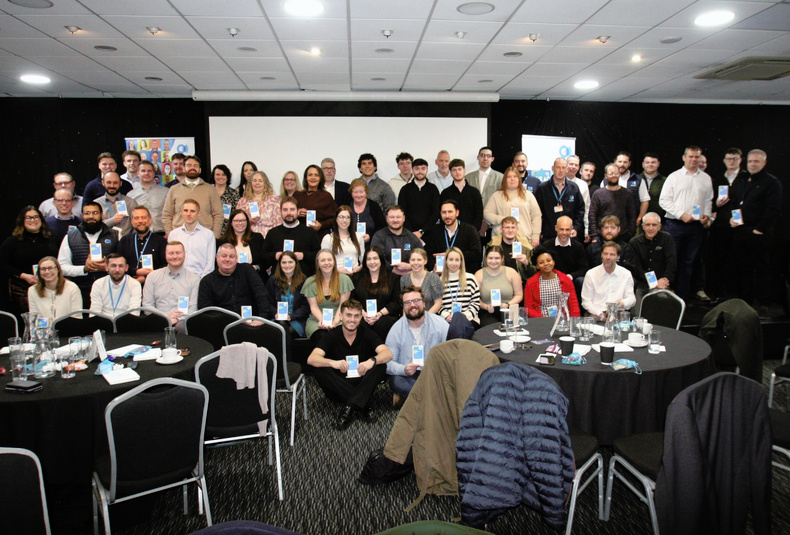
Pictured: Earn & Learn Apprenticeship Conference organised by SOCOTEC UK in 2025