St Basils generates £7 of social and economic value for every £1 invested - report
An independent 10-year evaluation shows St Basils’ pioneering model offers genuinely affordable housing that helps young people stay in work, avoid homelessness and develop independent lives.
St Basils pioneering Live and Work scheme has generated £7.97 of social and economic value for every £1 invested, according to a new independent ten-year evaluation carried out by the Centre for the New Midlands and funded by the Oak Foundation.
Since opening its first scheme in Sandwell in 2015, Live and Work has provided genuinely affordable housing for 236 young people, helping them sustain employment, avoid homelessness and move towards independent living.
The findings make a strong case for expanding similar stepping-stone housing models nationally at a time when high rents and insecure work continue to put young people at risk.
The scheme began with a simple question first asked by St Basils in 2013: how low would rent need to be for a young apprentice to live independently without debt or benefits? The answer was £42 a week, and St Basils built a model around it.
The first development, Apprentice House in Sandwell, opened in 2015 after an unusual coalition of housing providers, NHS partners, local authorities, charitable funders including LandAid, and development partner Equans came together to test whether genuinely affordable housing for young workers could exist.
Officially opened by Prince William, the scheme provided safe, secure accommodation at rents capped at £42 per week, including service charges.
A decade on, the results paint a picture not simply of homelessness prevention, but of lives stabilised before crisis takes hold.
Over the last ten years, the evaluation found that 236 young people have been housed through the scheme, with 76 per cent arriving from outside homelessness services. Residents have been better able to sustain employment, improve wellbeing and progress towards independent living.
Tenancy stability has strengthened over time, with median stays rising from six to seven months to 11–13 months.
Twenty-three per cent of residents moved into the private rented sector, a significant step for young people without family support, and the evaluation identified significant long-term savings to public services through reduced homelessness and improved outcomes.
Crucially, many of the young people supported were not already known to homelessness services.
They were working, studying or completing apprenticeships, but lacked family support or financial safety nets - the growing group for whom one rent increase, family breakdown or unexpected bill can trigger crisis and homelessness.
The report captures the emotional impact of stable housing as much as the economic one.
Young residents described lower anxiety levels, improved wellbeing and a greater ability to sustain work and plan for the future.
Dr Halima Sacranie, lead author of the report, said: “Young people told us that stability, affordability and control over their own space were transformative, reducing anxiety, improving wellbeing, and enabling them to sustain work and imagine a future.
“The SROI findings show that this is not only socially impactful but economically compelling.”
Jean Templeton, chief executive of St Basils, said: “Conventional methods, costs and partnerships simply didn’t stack up for this kind of scheme.
“But thanks to the incredible support of partners across housing, health, local government and the charitable sector, we proved that another approach was possible.
“For young people who cannot draw on family support, opportunities to work, save and plan for the future are often incredibly limited. Live and Work was designed to change that.
“One young person described their time in Live and Work as giving them ‘the space to breathe’. That, for me, sums up exactly why this matters.
“We hope the learning from Live and Work encourages the creation of similar stepping-stone housing offers across the country.”
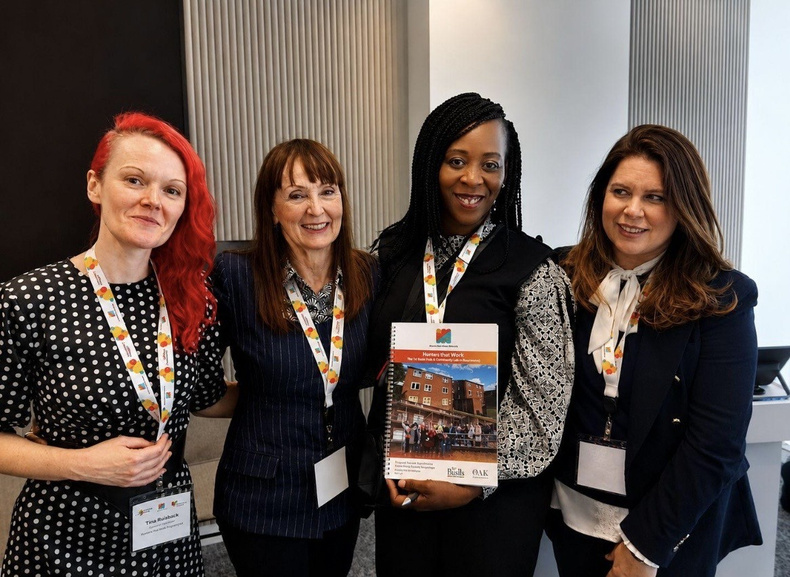
Pictured from left to right: Project co lead Thea Raisbeck, St Basils CEO Jean Templeton, St Basils director of progression Marsha Blake and Dr Halima Sacranie. project lead.