Two-thirds of Birmingham workers fear rapid pace of workplace change, new research reveals

Birmingham workers could be heading towards a growing skills crisis, according to new research from Arden University.
The research suggests many workers are struggling to keep pace with the rapid changes transforming today’s workplace.
The study of 2,000 UK employees found that two-thirds (66%) of workers in the region believe the pace of change within their industry is increasing, with skills becoming outdated faster than ever before.
Yet despite recognising the speed of change, only 65% say they are actively upskilling to keep pace.
Technological disruption is viewed as the biggest threat to long-term job relevance by two-fifths (42%) of Birmingham workers.
This is followed by economic instability and shifting job markets (32%), while 17% cite generational or age-related bias in hiring and promotion as their greatest concern.
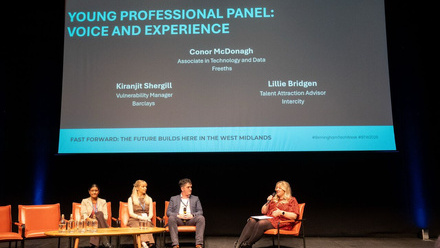
Dilshad Sheikh, (pictured) Provost and Chief Academic Officer at Arden University, said: "The disconnect between the pace of change and the urgency to upskill suggests a growing complacency across the Birmingham workforce, which could leave both employees and the wider economy vulnerable.
"The sense of vulnerability is clear. Workers are aware that the ground beneath their feet is rapidly shifting and, with uncertainty looming over jobs and industries, many fear their skills are falling behind.
"The question is no longer just about career progression, but about survival in a turbulent economy. Could this be the wake-up call the nation needs to confront its widening skills gap?"
The research coincides with the launch of Arden University's Future of Work and Learning Report, published to mark the institution's 10th anniversary.
Looking back at the past decade of work and learning while examining the challenges ahead, the report reveals that the half-life of workplace skills has fallen to less than five years, with some skills now becoming obsolete in under 12 months.
As a result, continuous learning and regular skills development are becoming essential for long-term career success.
Despite the growing need to develop new skills, more than a third (35%) of Birmingham employees are not currently upskilling. Among them, 24% believe they already have all the skills they need, a further 24% simply do not want to upskill, while another 24% say they struggle to find the time.
For those who are investing in their development, the motivation is clear. Nearly three-quarters (74%) say they are learning new skills to remain relevant in their industry.
Dilshad Sheikh added: "Continuous learning is the new currency for career longevity. Businesses aren't just looking for coders and data scientists.
They also need project managers who understand agile methodologies, marketing professionals who can leverage AI-powered analytics, and finance teams that are comfortable working with blockchain.
"Technology is now embedded in almost every role, and a reluctance to engage with it can become a career-limiting move.
"The 'job for life' is a relic of a bygone era. Today, we need to think in terms of a 'career for life', which requires constant adaptation.
Employees who recognise this and actively pursue new skills are not just protecting their current roles; they're building a foundation for future opportunities that may not even exist yet."
As industries continue to evolve, the gap between the skills employer’s need and those workers possess risks widening further, threatening both productivity and long-term career stability.
"The gap between recognising change and taking action is where the real challenge lies," explained Dilshad. "While most employees acknowledge that the workplace is changing rapidly, a significant proportion are not taking proactive steps to secure their future."
He added that the widening skills gap is not only an issue for individual workers but also poses a significant challenge for the wider UK economy.
"Companies will struggle to innovate and compete globally if they cannot find or develop the talent needed to implement new technologies and processes.
A mismatch between the skills of the available workforce and employers' needs can also lead to higher long-term unemployment, even when job vacancies exist.
"An economy's capacity for growth is intrinsically linked to the capability of its workforce. A national skills deficit acts as a brake on economic expansion."
In its Future of Work and Learning Report, Arden University outlines three key recommendations to help businesses prepare their workforce for the future:
Build resilience through skills
Provide employees with opportunities to develop both technical and human skills, including digital fluency, AI literacy, adaptability and creativity. This means enabling people to upskill while they work.
Design flexible and inclusive learning
Create learning opportunities that fit around day-to-day responsibilities by offering modular, stackable and asynchronous learning. Flexible access helps employees develop new skills at a pace that works for them.
Foster partnerships for shared responsibility
Strengthen collaboration between businesses, educational institutions and government to ensure the workforce is equipped with the skills needed for the future economy.
Dilshad Sheikh said: "We don't want to overwhelm workers—or employers—with more courses or tools that they can't easily access. Instead, we need to build a system that is resilient, inclusive and designed for continual reinvention.
"From a macroeconomic perspective, a stationary workforce is a recipe for stagnation. For the UK to thrive in the age of AI, we need a dynamic, adaptable and highly skilled labour force.
"Relying on the skills of the past to power the economy of the future is a flawed strategy."
The full Future of Work and Learning Report is available to download from Arden University here.