
Why South Asian Heritage Month matters in the workplace
Written by Bhavik Parmar, executive director of Sampad South Asian Arts and Heritage
As Executive Director of Sampad, I spend much of my time speaking with businesses, schools, healthcare providers, community organisations and cultural partners across Birmingham and beyond.
One thing that consistently strikes me is how many organisations genuinely want to create workplaces where people feel valued, connected and able to thrive. Yet creating that sense of belonging requires more than policies and statements. It requires us to understand the people behind the job titles. That is one of the reasons South Asian Heritage Month matters.
For many organisations, South Asian Heritage Month is marked through a social media post, a lunchtime event or perhaps a celebration of food and culture. Whilst these activities can be valuable, they only scratch the surface of what this month represents. South Asian Heritage Month offers us an opportunity to recognise the stories, experiences and contributions of South Asian communities, whilst reflecting on what those experiences can teach us about creating stronger, more inclusive workplaces.
As a British Gujarati, I have spent much of my life navigating different spaces and identities. Home, school, work and community all brought different expectations and experiences. Whilst every South Asian person’s story is unique, many of us understand what it feels like to balance multiple cultures at once.
Growing up, there were moments when I wanted to fit in rather than stand out. Whether it was wondering if taking Indian food into school or work would attract unwanted attention, translating cultural references for friends and colleagues, or trying to explain to family members what a career in the arts actually involved, there was often a sense that I was moving between different worlds. It often felt easier to adapt myself to fit into different environments than to explain where I came from and what shaped me.
That is why South Asian Heritage Month can be so powerful in the workplace. It creates opportunities for colleagues to understand our backgrounds and experiences without individuals feeling responsible for becoming the spokesperson for an entire community. No one person can represent the richness and diversity of South Asian experiences, but heritage months can create space for those stories to be shared, celebrated and understood.
In a city like Birmingham, where South Asian communities have helped shape the social, economic and cultural fabric of the region for generations, it is impossible to tell the story of the city without recognising their contribution. South Asians are teachers, healthcare professionals, entrepreneurs, artists, engineers, community leaders and business owners. Our heritage is not a niche interest or a side conversation. It is woven into the story of modern Britain.
But South Asian Heritage Month is not only about supporting South Asian employees. It is an opportunity for colleagues to learn from one another.
South Asian communities are often spoken about as though they are one group, but the reality is far richer. South Asia encompasses a huge diversity of languages, faiths, traditions and histories, meaning no single person can represent an entire community. The most meaningful workplace conversations happen when organisations create space for people to share those experiences authentically rather than making assumptions about them and this is where arts and culture can play a particularly powerful role.
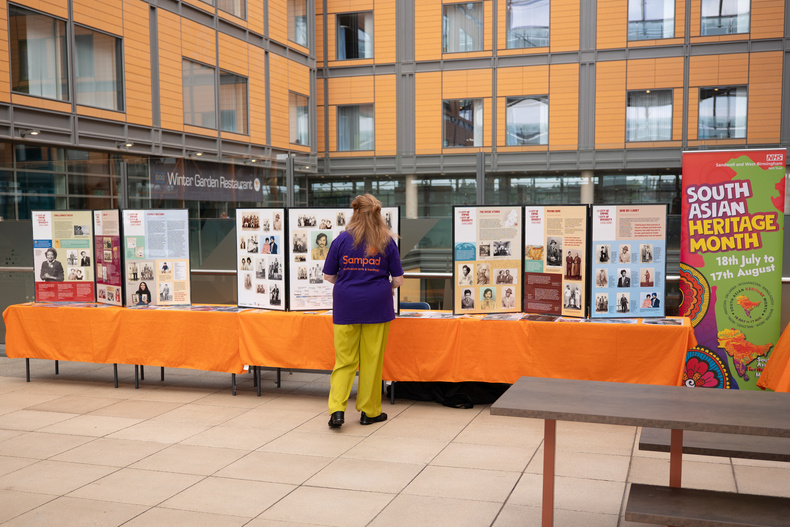
I was recently reminded of this whilst working with colleagues at Midlands Metropolitan University Hospital as they prepared their South Asian Heritage Month celebrations. Preeti Puligari, Library and Knowledge services manager and one of the organisers of this year’s programme, described the theme of “Unity in Diversity” as particularly relevant to the NHS workforce. Their programme includes storytelling, performances, creative activities and opportunities for staff to share experiences and learn from one another.
What I found particularly powerful was the recognition that South Asian Heritage Month is not simply for people with South Asian heritage. As the Trust explains, it is an opportunity for all colleagues to better understand the histories, cultures and experiences that shape the people they work alongside every day. Their message captures the value of this perfectly: “A team that understands one another – truly understands one another – doesn’t just work better. It cares better.”
Perhaps the most important question organisations should ask themselves during South Asian Heritage Month is this: what happens when the month ends? The organisations making the greatest progress are those that view heritage months as a starting point rather than a destination. They use these moments to open conversations, build relationships and deepen their understanding of the people they employ and the communities they serve.
South Asian Heritage Month is not simply about celebrating the past. It is about recognising the contribution South Asian communities continue to make today and creating workplaces where people feel understood, valued and able to be themselves.
The invitation to connect with us will always stay open. Find out about our corporate partnerships here.