
Why your happy clients might be leaving you

Written by Liz Ashton from Symbioss
As a director of a UK services company, you may well deliver excellent work, yet find yourself in the same position as other CEOs, with sales growth having flattened or worse.
Revenue growth is strongly associated with client relationship health, but how do you measure it? One issue for companies is that they often rely on the wrong signals when reviewing.
CEOs frequently mistake invoicing as evidence that a client relationship is secure. “They seem happy” is another misleading measure.
Don’t rely on invoice value
To reduce risk and grow revenue, we recommend a new approach to client relationships. This involves systematic client management, shifting the organisation from individual intuition to structured systems for key client accounts.
For example, consider how you measure success. Revenue has traditionally served as “proof of safety,” but it is a lagging indicator. By the time a decline in invoicing appears in the company accounts, the client may have stopped ordering altogether.
Other measures of client relationship health
Companies also use customer satisfaction to predict client retention, but we find this unreliable.
Bain & Company found that 60-80 per cent of clients who left a provider had previously rated themselves “satisfied.”
Satisfaction is just a baseline and does not reflect commitment to your future mutual growth. Another measure is NPS, which gauges how likely clients are to recommend you. While useful and common, NPS does not account for competitors, cultural differences, or business blockers.
A “single-threaded” approach, where you rely on just one contact within the client organisation, is risky. If your only contact moves roles, your entire network within that organisation can vanish overnight.
This is why “stakeholder breadth” - the width of your network across different departments is another measure; it turns out it's a strong leading indicator of account resilience. A wider network helps you surface blockers – people who you may not even know. And they exist despite your main contact being one of your champions.
In summary, there are several ways to measure relationship health, and each has its own trade-offs:
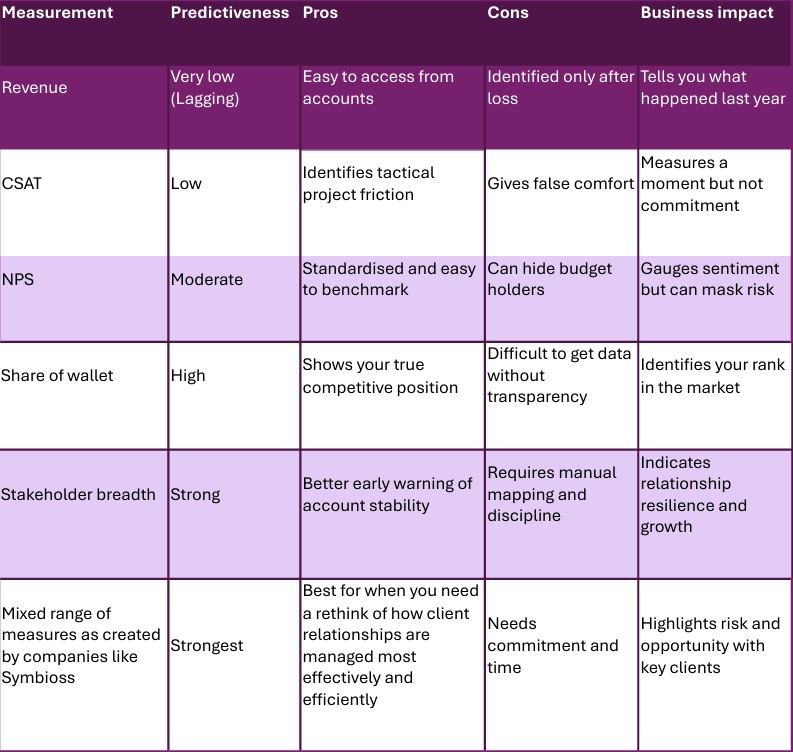
In our experience, predicting growth requires a different, more systematic, and structured approach to managing your client relationships. So instead of settling for “satisfied”, you should ask yourself if you are becoming more valuable to your clients. Hand in hand with this, focus on widening your contacts and understanding their long-term plans.
At Symbioss, we have developed a system to measure, plan, act, and govern client relationships – which we implement alongside your teams. We developed it after many decades of managing customer relationships and experiencing the same painful issues.
If you're feeling the pressure of stagnant sales despite doing great work, and you would like to chat about how to spot relationship drift before it turns into a loss, do get in touch.