AI innovation will help regulated industries manage critical document changes

DeltaXignia, a global company specialising in content and data ‘compare-and-merge’ software and services, has teamed up with Aston University to explore how AI can transform the way organisations manage change within complex digital documents and datasets at scale.
The Knowledge Transfer Partnership (KTP) will see the University’s AI experts work alongside DeltaXignia to integrate AI and machine learning into its software.
It will explore how these techniques can be used to identify changes, produce predictive analytics, and support additional capabilities.
The KTP will expand the company’s expertise in document and data change management and aims to help tackle a growing need for businesses to make sure their data and content are accurate and of high quality – an essential step for adopting their own AI models.
Employee-owned, Malvern-based DeltaXignia’s software for comparing complex files is widely used in highly regulated industries globally.
This includes well-known companies in the aviation, financial services, life sciences and legal sectors.
The company’s software and services help organisations detect and manage changes in documents and data where precision is paramount.
Differencing and merging software is used to track changes between two or more versions of the same digital document or dataset.
By checking line by line, or even character by character, the software recognises precisely what has changed, what has stayed the same, what has moved location, and where conflicting edits need to be resolved at every level of the document or dataset.
In the safety-critical aviation industry, for example, new aircraft come with hundreds, if not thousands, of technical manuals.
Compare-and-merge software highlights every addition, removal and alteration made during the complex drafting process, ensuring manufacturers can consolidate all revisions into a single, accurate set of manuals to accompany each aircraft.
However, AI could transform this because as well as showing what has changed between versions, it has the potential to spot patterns.
These could help businesses predict future updates, suggest the best way to handle conflicting revisions, and provide clear explanations that make changes easier to understand.
Through this project, the KTP team will investigate how machine learning and generative AI can be applied safely and effectively to the company’s technology.
The project will focus on developing AI models that can detect document changes automatically and predict likely future changes.
It will also ensure that new tools developed are explainable and accountable, avoiding what is known as ‘black box’ AI.
This is where it is difficult or impossible to see how an AI is making its decisions – a common feature of existing, ‘off-the-shelf’ tools.
Alongside technical advances, the KTP will also evolve the company’s business model.
It plans to increase its compare-and-merge consultancy and training services (including AI, as this area of the business expands), and to launch new AI-enabled software products under licensing.
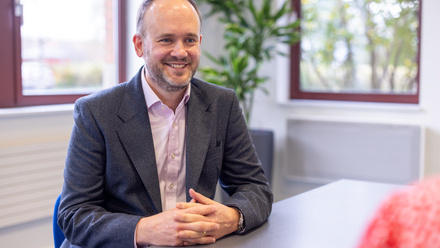
Eithne Devine-Hynes (pictured), CEO of DeltaXignia, said: “AI presents a huge opportunity for us to enhance our products and grow our business.
“Our customers rely on us for absolute precision. This partnership with Aston University gives us the expertise, structure and confidence to explore AI adoption in the most responsible and impactful way.”
Professor Abdul Sadka, director of The Sir Peter Rigby Digital Futures Institute at Aston University, will lead the academic research team working with Dr Farzaneh Farhadi from the School of Computer Science and Digital Technologies.
He said: “This collaboration is about blending the proven strengths of DeltaXignia’s software with the possibilities of AI.
“By combining research with real-world application, we aim to create innovations that are practical, explainable and trusted by the industries that need them most.”
Knowledge Transfer Partnerships, funded by Innovate UK, are collaborative projects that bring together a business, an academic partner, and a qualified associate to deliver strategic innovation and business improvement.
Aston University is a national leader in the programme, ranked joint-first in the UK for volume of active projects and first for overall project quality.