Aston University joins forces with digital health company for eye care study
Aston University have joined forces with digital health company Globe Biomedical to research how everyday environmental conditions affect eye health.
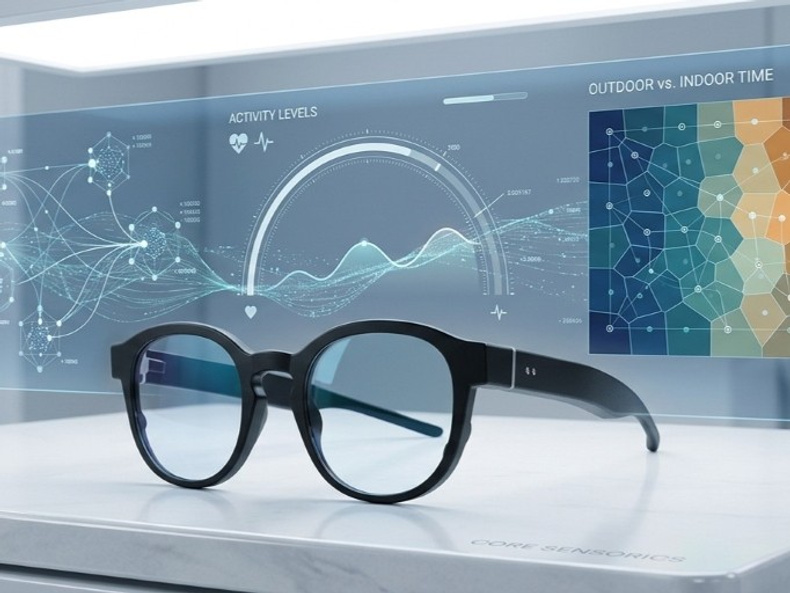
The collaboration will use Globe Biomedical’s Blink Frames, a smart eyewear platform designed to monitor eye-related activity and environmental conditions through ordinary-looking spectacle frames.
The technology will enable researchers to collect real-world data on factors such as light exposure, near-work behaviour and blinking, helping them better understand their impact on eye health and conditions such as myopia (short-sightedness).
The research at Aston is led by Dr Sayantan Biswas and Professor James Wolffsohn, whose work focuses on myopia (short-sightedness), ocular biometry, which is the measurement of the eye to track myopia progression and lens power, and the effects of light exposure and near work on the eye.
The study forms part of broader work investigating how real-world visual environments and behaviours influence ocular health and myopia.
The Aston team is using Blink Frames to capture continuous ocular and environmental data from participants going about ordinary daily life.
A sensor array captures the variables that actually drive ocular health outcomes, all day, with no action required from the wearer.
It is the first time that ophthalmology and optometry have had continuous monitoring, in a similar way to other areas such as cardiology or endocrinology, rather than relying solely on data gathered during appointments.
Myopia is increasing across the global paediatric population at a rate that has been called an epidemic by every major body in the field, and the most effective behavioural intervention available, time outdoors, has never had a reliable way to be prescribed, monitored or verified.
Ocular surface disease is increasingly understood as lifestyle-driven, which means it cannot be understood at all without lifestyle data. In both cases, the science is ahead of the instrumentation, and the instrumentation is the constraint.
Blink Frames monitor:
- Light exposure and spectral composition, distinguishing genuine outdoor illuminance from indoor artificial light using dynamic, sun-angle-aware thresholds rather than a fixed lux cut-off so outdoor time holds up across seasons and latitudes.
- Near-work behaviour and working distance, classified continuously rather than recalled at a follow-up appointment.
- Spectacle wear compliance, measured directly, the single variable that determines whether any prescribed intervention is actually working.
- Blink rate and blink completeness, captured in high-rate bursts throughout the day, shipping in the current firmware release.
- Eye-level temperature, humidity, and barometric pressure, giving environmental context to every one of the above.
The leading-edge team at Aston putting Blink Frames through their paces is the strongest signal yet that continuous ocular monitoring has arrived as a serious research instrument.
Globe Biomedical has deployed Blink Frames with research and clinical partners across the UK, Europe and the US.
The collaboration with Aston is structured to expand from its current pilot phase into a longer-running cohort, generating the kind of longitudinal behavioural dataset that does not currently exist anywhere in eye care.
Dr Sayantan Biswas, lecturer in Optometry and lead investigator at Aston University, said: “Much of what we know about light exposure, near work and spectacle-wearing behaviour outside the clinic still relies on participants remembering and reporting what they have done.
“Being able to measure these behaviours objectively throughout everyday life could give us a much clearer picture of the visual environment people actually experience. Our first priority is to evaluate what Blink Frames can measure reliably and how these data can be incorporated into rigorous vision research.”
Joshua Park, chief executive officer at Globe Biomedical, Inc, said: “Aston asked the question every serious researcher asks first: what can this actually measure, and how well? That is the right question, and it is why we wanted to work with them.
“They are not looking for a gadget. They are looking for instrumentation they can build a decade of studies around – and we built Blink Frames to be exactly that.”