
HS2 reaches major milestone with final Curzon Street viaduct launch
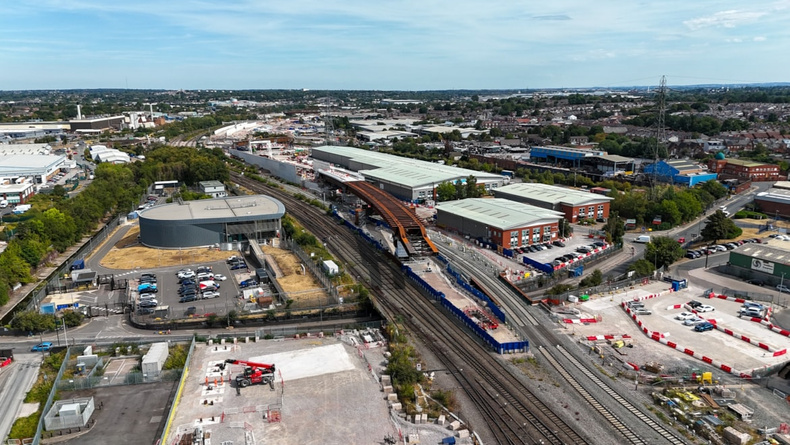
HS2 engineers have completed the first major phase of work to launch the Duddeston Junction Viaduct over the Birmingham to Derby railway lines.
It marks the start of a huge operation to cross six railway tracks – three freight lines and three passenger lines - which is expected to conclude next summer.
Duddeston Junction is the first, and longest, in a series of five interconnecting viaducts – known as the Curzon Approaches - which weave through Birmingham’s industrial heartlands on the approach to Curzon Street Station.
While Curzon 2 is visually striking, Duddeston Junction Viaduct stands out for its geometry and complexity. The structure follows a varying horizontal curve and has a three percent gradient, rising from the ground to sit 12 metres above the existing tracks. This makes construction, logistics and alignment significantly more challenging.
This month, the engineering team behind the build and launch operation reached their first major milestone, as they successfully launched the first 170 metres of the 700-metre-long structure over two key freight lines that transport goods into the city.
Tony Zakaria, HS2’s senior project manager for the Curzon Approaches said: “Launching the fifth and final viaduct on the Curzon Approaches is a clear sign of the progress we are making to bring high speed rail to Birmingham.
“This final mile stretch of the HS2 route into the city centre is extremely challenging and we’ve worked exceptionally hard, in conjunction with Network Rail, to plan the whole operation with minimum disruption to both passenger and rail freight services”.
HS2’s construction partner, Balfour Beatty VINCI (BBV), began the extensive preparation works for Duddeston Junction Viaduct in 2023, moving major utilities and tackling heavy ground contamination ahead of diverting two of the three freight lines onto a new bridge and embankment.
This vital step would create a safe working space for construction and assembly of the viaduct and its supporting piers and portals.
To move the freight lines, BBV constructed the Duddeston Mill Road Underbridge. In partnership with Network Rail, the two railway lines were then re-aligned, establishing a 20m wide way between the existing lines. The realigned tracks cross the new bridge, creating the clearance needed for HS2’s construction.
The entire programme is being delivered in a heavily constrained site, with BBV’s team of up to 90 operatives and engineers working in a tight space sandwiched between six live railway lines and a busy industrial estate.
The weathering steel viaduct is formed of 14 spans, each around 55 metres long and cumulatively weighing up to 6835-tonnes. To successfully cross all six railway lines, the team must assemble and launch seven spans.
Each completed span is added to the rear of the structure, which is then pulled forward, using a tried and tested slide technique. After safely clearing the railway lines, the seven remaining spans will be lifted and lowered into place by crane on the opposite side of the railway.
Ross Rendell, section manager at Balfour Beatty VINCI said: "Duddeston Junction Viaduct is hugely complex and a key section of the HS2 route that will take trains in and out of Curzon Street Station.
“The 705-metre-long structure is being built inside a narrow space next to a live railway, where it curves above Birmingham’s industrial heartland at an incline. The viaduct also crosses over six railway lines, adding further challenges to its construction. I’m incredibly proud of the way my team has overcome these hurdles, as this huge viaduct continues to take shape.”
Duddeston Junction Viaduct is supported by one abutment, two steel piers, four portals and eight concrete piers. It is the longest viaduct on the Curzon Approaches by over 400 metres – eclipsing Curzon 1 which measures around 300 metres.
HS2 and BBV are now working with Network Rail to plan for the next phase of works – crossing the passenger railway lines – which is scheduled to begin in December.