Lichfield Cathedral leads national conversation on Net Zero and heritage
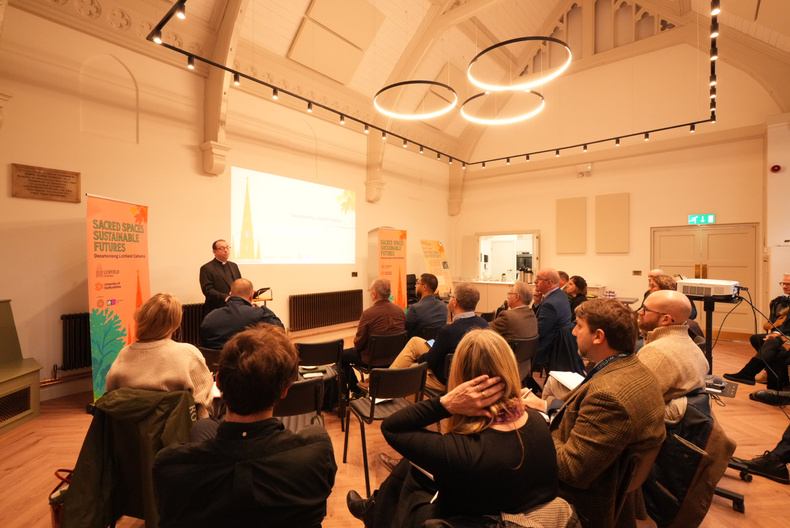
Leaders from the Church of England, cathedrals across England and the heritage sector gathered at Lichfield Cathedral last week to explore how historic buildings can cut their carbon emissions without compromising their heritage.
The event, held in the cathedral’s newly refurbished College Hall, showcased progress on Sacred Spaces, Sustainable Futures.
The Knowledge Transfer Partnership (KTP) is developing practical tools to help churches and cathedrals reduce their emissions while caring for their historic fabric.
The project is a collaboration between Lichfield Cathedral, the University of Staffordshire, the University of Birmingham and Innovate UK.
It is funded by the Church Commissioners for England and Innovate UK.
Attendees included:
- senior figures from the Church of England’s National Net Zero Carbon Programme
- representatives of English cathedrals
- the Diocese of Lichfield
- the Midlands Net Zero Hub
- Innovate UK and both partner universities
The Church of England has committed to reaching net zero carbon by 2030, a significant challenge for historic buildings.
At Grade I listed Lichfield Cathedral alone, meeting that target will mean cutting carbon dioxide emissions by around 160 tonnes, a reduction of about 90 per cent.
Following a welcome from Canon Gregory Platten, delegates heard from Paul Sampson, regional principal energy projects officer at the Midlands Net Zero Hub.
He explained how organisations can use data, carbon modelling, emerging technologies and financing opportunities to identify priorities, secure feasibility funding and develop investable net zero projects.
Dr Elena Imani, sustainability project manager at Lichfield Cathedral and KTP associate, then shared findings from the project’s first year. Her research is looking at how the cathedral can make significant carbon reductions while protecting its historic structure and continuing to serve its communities.
A key focus of the day was the development of a practical toolkit that churches and cathedrals across the country could use to support their own decarbonisation. Delegates showed particular interest in the use of environmental data loggers and building performance modelling. These are helping researchers understand how historic buildings perform and identify the most effective improvements.
Dr Imani said: “The ambition of this project extends beyond Lichfield Cathedral. Our aim is to develop tools, evidence and approaches that can be adapted and applied across the wider cathedral and church sector.
“Bringing together specialists from such a diverse range of organisations has been invaluable in helping shape that work.”
Refreshments on the day were provided by SALT at Lichfield Cathedral.