Region must ‘set out its stall’ to seize growth opportunities
Business leaders have been urged to stop being “apologetic” about Birmingham and the wider West Midlands as the region looks to capitalise on major growth opportunities.
The call came at Greater Birmingham Chambers of Commerce’s Quarterly Business Report launch event for Q2, held at Birmingham City University’s Curzon Building.
The Chamber’s Quarterly Business Report provides a regular snapshot of business sentiment, recruitment, investment intentions and cost pressures across Greater Birmingham.
The Q2 launch - with its theme of ‘Navigating Global Uncertainty, Seizing Local Opportunity’ - brought together regional businesses to examine how firms can navigate international volatility while making the most of opportunities closer to home.
Delegates heard from Jo Roberts, head of corporate affairs at Birmingham Airport, Aaron Dardi, founder and managing director of energy procurement experts ENERGYbubble, and Terry Gibson, development director at Royal Birmingham Conservatoire.
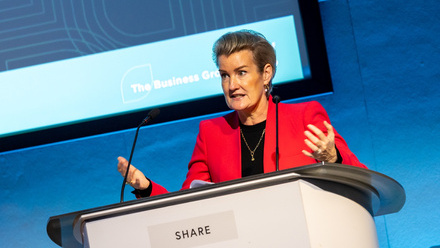
Ms Roberts said Birmingham Airport remained resilient despite a challenging backdrop for the aviation sector, including squeezed household budgets, geopolitical disruption and constrained airline capacity.
She said the airport handled 13.7 million passengers last year and was continuing to grow year-on-year.
She also highlighted major opportunities in cargo, with Birmingham seeing increased demand as capacity in the southern airport system remains under pressure.
Ms Roberts said imports and exports through Birmingham Airport had more than doubled over the past decade.
She said: “There is a huge opportunity for the airport and for the region with HS2 that will only elevate the connectivity that we’ve got with road and rail.
“If you look at the investment, the growth, and all of the amazing businesses around us, there is such opportunity for the area if we start setting out our stall properly.
“What I find with Birmingham and the region is we’re quite apologetic, and we hide behind a bushel in terms of the amazing story that we’ve got to tell.”
She said the airport is also investing in infrastructure, passenger experience and sustainability, including runway and baggage system improvements, new retail and hospitality offers, and solar power as part of its net zero ambitions.
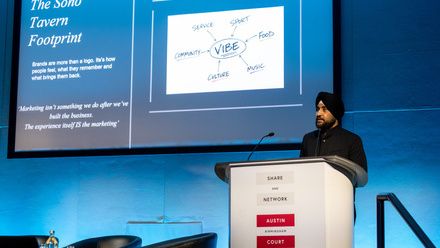
Mr Dardi told delegates that uncertainty had become a “normal state” for businesses and that firms needed to adapt their models rather than wait for stability to return.
He said many firms were now placing greater emphasis on cost control, client retention, automation and strategic planning.
He added that businesses had reacted more calmly to recent global tensions than they did during the 2022 energy crisis, with SMEs increasingly taking a longer-term view of risk.
Mr Dardi said: “Revenue isn’t the hard thing to manage anymore. It’s how creative you can you get with managing costs.”
He also warned that businesses were being hit by policy changes and infrastructure-related energy costs, including increases linked to transmission network upgrades.
However, he said manufacturers and producers should explore new support through the British Industrial Competitiveness Scheme, which is expected to broaden access to energy cost relief from October.
Meanwhile, Terry Gibson said Birmingham’s cultural institutions - such as the Conservatoire, the CBSO and Birmingham Royal Ballet - have the potential to drive global opportunities for the city with the right funding support.
He added: “We have an incredible opportunity to expand outwards and showcase what Birmingham can deliver.
“The challenge is the finances. The money we get from Arts Council doesn’t position us to be global in the way we would like to be.
“We are becoming increasingly reliant on private investment and philanthropists.
“We would like to have support to become more global as the finances don’t allow it currently.
“It’s a challenging environment but it’s not insurmountable. There are also international opportunities to bring people here and share via cultural exchange as well.”
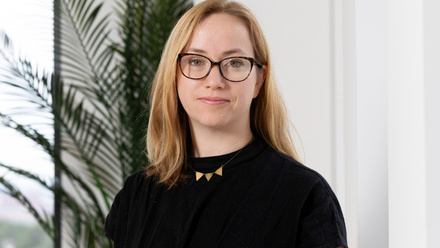
The GBCC’s head of policy Emily Stubbs presented an overview of the report for Q2, which revealed recruitment challenges facing Greater Birmingham businesses have eased to their lowest level since summer 2021 – but export activity weakened sharply.
And delegates were treated to a musical performance from Royal Birmingham Conservatoire duo Zinnia Smart and Aidan Hopkins.
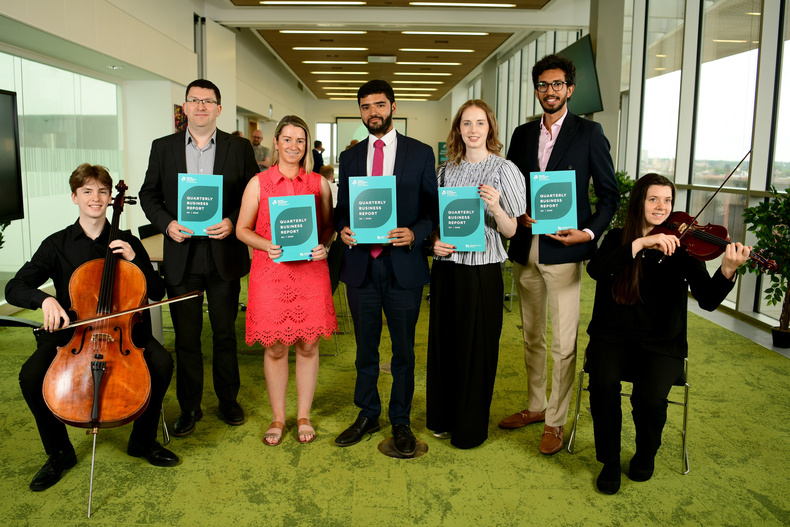
Pictured: From left - Adrian Hopkins, Terry Gibson, Jo Roberts, Raj Kandola (deputy CEO, GBCC), Emily Stubbs, Aaron Dardi and Zinnia Smart