Universities celebrate two years of groundbreaking Baskerville research
A landmark event at the Library of Birmingham marks two years of the Small Performances reserch project, bringing together scholars, craftspeople and scientists to share pioneering findings.
The project, which investigates the renowned typographic punches of John Baskerville (1707-75) through heritage science and practice-based research, is a collaboration between Birmingham City University (BCU), University of Cambridge and Cambridge University Library.
John Baskerville was England's foremost printer, and his typeface remains familiar to billions of readers and computer users across the world.
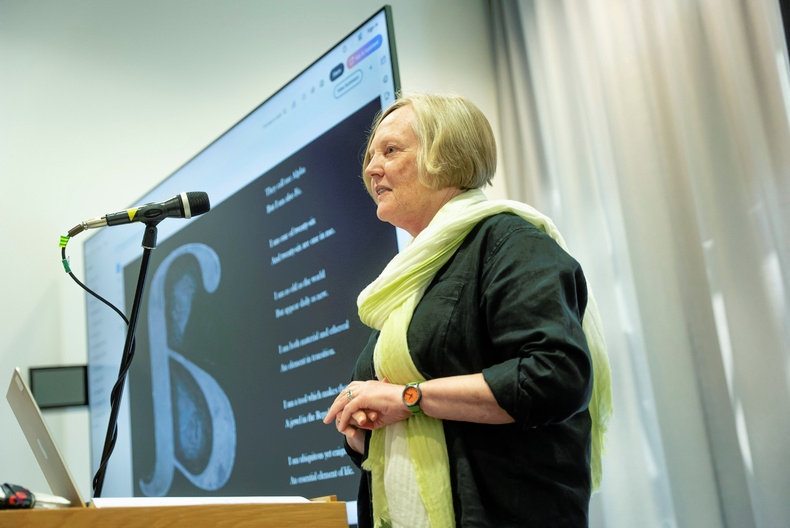
Co-lead of Small Performances, Dr Caroline Archer, (pictured) who is also Professor of Typography at BCU and Chair of the Baskerville Society, presented a poem titled ‘They call me alpha’.
It charted the story of the creation of a single a punch in Birmingham, to its engagement with the French Revolution, rediscovery in 1917, return to Britain in the 1950s, and now its modern-day impact.
“The project is providing an exciting opportunity to investigate and re-think the Baskerville punches,” said Professor Archer.
“By creating a narrative of how the punches circulated across 300 years, we can not only produce a deeper understanding of the punches themselves but by following them as they move through various levels of society and across cultures they offer a social commentary and highlight human behaviour from a detached, material perspective.”
Over the past two years, the research team - including printing historians, archaeologists, heritage scientists, jewellers, engravers, and type designers – has employed a range of methods to unlock the secrets held within the punches.
These included high-resolution 3D digital microscopy, scanning electron microscopy, elemental and microstructural analyses, and practical reconstruction experiments conducted with craftspeople.
Over the past two years, the research team - including printing historians, archaeologists, heritage scientists, jewellers, engravers, and type designers – has employed a range of methods to unlock the secrets held within the punches.
These included high-resolution 3D digital microscopy, scanning electron microscopy, elemental and microstructural analyses, and practical reconstruction experiments conducted with craftspeople.
They have also engaged practical work in iron smithing, engraving, stone carving and letterpress printing, using past knowledge to reactivate endangered crafts.
At the heart of the Small Performances project is the collection of typographic punches designed, cut, and used at Baskerville's Birmingham workshop, now held at Cambridge University Library.
Researchers have been able to capture microscopic surface details of the punches through a technique known as Reflective Transformation Imagery which reveals marks left by metalworkers and punchcutters, offering a rare opportunity to study crafts which have largely disappeared
Professor Marcos Martinón-Torres, Pitt-Rivers Proffessor of Archaelogical Science at University of Cambridge, and co-lead of Small Performances, said “These little punches are prompting us to do more.
“We’ve created a catalogue of over 3,000 punches, with hundreds of them being digitised and made freely available online.”
“This project means we are learning from each other and from the punches, providing something for the present and the future.”