
What Birmingham's canals reveal about how the city grows
Written by Siena Palese StayKula
Here's a question most people in this city have never stopped to ask: why does Birmingham, of all places, have more miles of canal than Venice?
The answer is entwined with Birmingham’s industrial history.
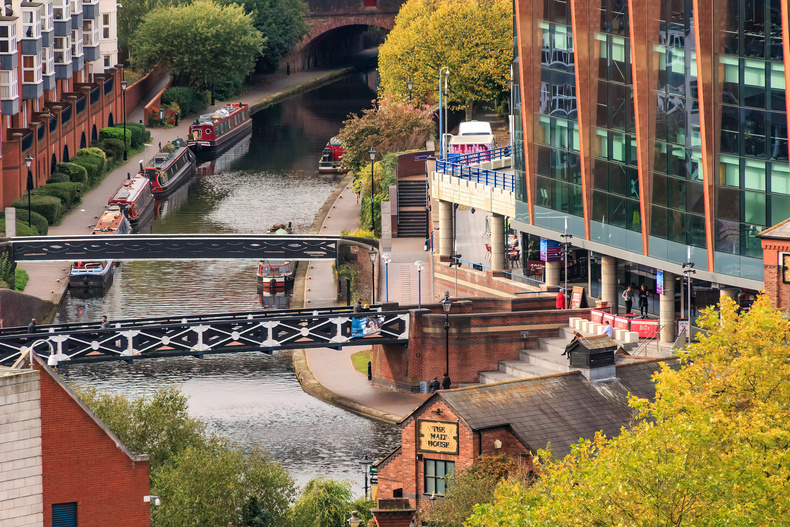
Birmingham built its 35 miles of canal during the industrial revolution. This was the fastest way to move coal, iron, and finished goods in and out of a city that had nothing to sell but what it made with its own hands.
By the late 1800s, over 100 miles of interconnected canal made up the Birmingham Canal Navigations, a network so dense and so busy that narrowboats converging on the Black Country at the same hour each day created something close to a tidal effect.
That is the part of a well-known story in Birmingham. What gets left out is what happened next.
The canals fell into disuse once rail and road took over. By 1980, commercial traffic on them had stopped entirely.
For a while, they sat derelict, lined by empty warehouses, a monument to an economy that had moved on without them. And then the city did something that will begin its long-standing history of revitalization: it rebuilt around them.
Brindleyplace, Gas Street Basin, the towpaths now lined with bars and offices instead of coal wharves. Birmingham found a miraculous new purpose for the exact infrastructure that had been left behind. That instinct, to reroute rather than retire, is an important message for Birmingham, because it repeats again and again, and this time it's showing up in how people live here.
The city is growing faster than its housing model can keep up with
Birmingham is currently second in the UK for new business start-ups, trailing only London.
Its economy grew by £1 billion in a single year, and it now sits second outside London, behind only Leeds, for employment in financial and professional services. Twenty thousand graduates leave the city's universities every year, feeding a workforce that's younger and more skilled than the national average.
And running straight through the middle of all of it is a new kind of infrastructure bet: HS2's Curzon Street station, the UK's first new intercity terminus in more than a century, set to put London 45 minutes away and already pulling development into Digbeth and Smithfield ahead of its opening.
I work in serviced apartments in Birmingham, and this is the part of the growth story that rarely makes it into the headlines: every one of those numbers, start-ups, graduates, professional services jobs, translates into people who need somewhere to live, often quickly, often for a matter of weeks or months rather than years.
A contractor brought in for an HS2-linked project. A graduate taking their first role and needing a base before they commit to a flat. A relocating team from London or overseas, testing whether the move makes sense before they sign a twelve month lease.
Birmingham's traditional housing options weren't built for that kind of movement. A hotel works for a week. A long lease assumes you already know you're staying. The gap in between, weeks to months, flexible but not transient, is where a lot of the city's actual working population now sits, and it's one of the least visible parts of the growth story even though it touches almost every business bringing people into the city.
An old pattern, playing out somewhere new
None of this is an accident, and none of it is new behaviour for Birmingham.
This is a city that has always treated its infrastructure as something to reinvent rather than mourn. The canals didn't survive because they were pretty. They survived because Birmingham kept finding reasons to need them, first for coal, later for leisure and regeneration.
Housing is following the same arc. What used to be a binary choice, hotel or long-term let, is being rerouted into something built for how people are actually moving through the city now: in and out, on shorter timelines, often without much notice.
It's the same instinct that turned Gas Street Basin from a derelict wharf into one of the city's most recognisable spots, applied to a much newer problem.
What this means for businesses operating here now:
- Treat existing assets as reroutable, not disposable. Birmingham's growth sectors, professional services, life sciences, technology, all sit on top of premises, skills, and supply chains built for something else.
- Watch what the city funds, not just what it announces. HS2's Curzon Street investment is already reshaping Digbeth and Smithfield before a single train runs. Infrastructure spending is usually the earliest signal of where opportunity will land next.
- Factor housing and relocation logistics into growth plans early. Any business bringing in contractors, new hires, or relocating teams will run into the same hotel-to-lease gap, and it's easier to plan for than to solve last minute.
- Don't wait for a sector to fully mature before positioning in it. Birmingham's rise in financial and professional services happened alongside, not after, its manufacturing decline.
Next time someone asks for a fun fact about Birmingham canals, you’re covered.