
Why having a website is no longer enough for UK businesses
Written by Reza Pazhoheshnia from Star IT Euro
For many years, having a website was considered one of the key signs that a business had established a professional digital presence. A company would create a homepage, explain its services, add its contact details and perhaps publish occasional news or updates.
That approach was once enough.
Today, however, customer behaviour has changed dramatically. People increasingly discover businesses through Google, social media and online recommendations. They compare providers before making contact, expect to be able to purchase or book online, and often make their first judgement about a company within seconds of encountering it digitally.
As a result, businesses should no longer be asking simply, “Do we have a website?”
A more useful question is: “Is our website actively helping our business grow?”
From digital brochure to business growth platform
A traditional website often operates like an online brochure. It tells visitors who the business is, what it offers and how to get in touch.
A modern business website needs to do considerably more.
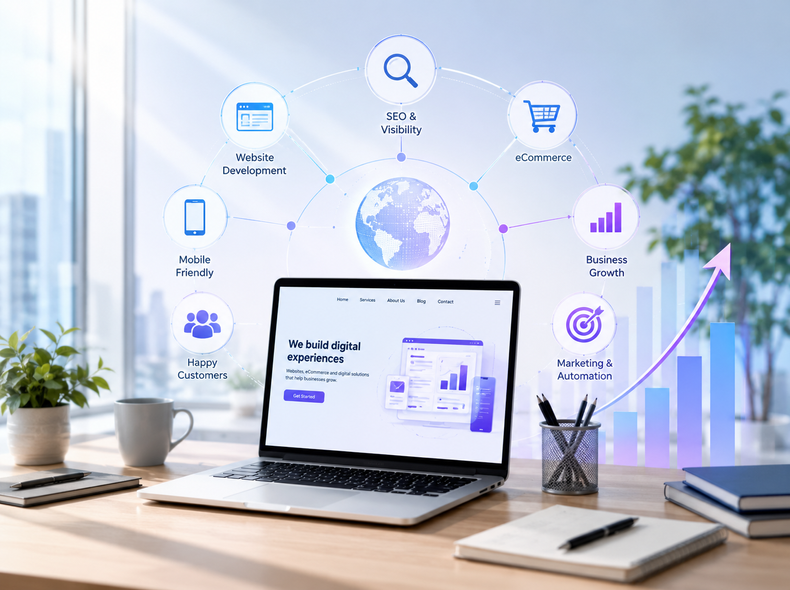
Depending on the type of organisation, it can become the centre of a wider digital ecosystem connecting search engines, online sales, enquiries, bookings, social media, marketing and customer communication.
For a retailer, this may mean integrating eCommerce and online payments. For a service business, it could mean appointment booking, quotation requests or lead generation. For a training provider, it may include online learning and digital content.
The exact technology will vary from one organisation to another, but the principle remains the same: the website should have a measurable business purpose.
Being online is different from being found online
One of the biggest misconceptions surrounding websites is that launching one automatically makes a business visible. It does not.
Millions of websites compete for attention, and potential customers increasingly rely on search engines to decide which businesses to investigate.
This makes search engine optimisation (SEO), relevant content and local Google visibility an important part of a company's wider digital strategy.
A beautifully designed website that cannot be discovered by its intended audience has limited commercial value.
Businesses therefore need to consider SEO from the beginning of a website project rather than treating it as something to add afterwards.
This includes the structure and performance of the website, the relevance of its content, mobile usability, local search visibility and the way individual services or products are presented to search engines and potential customers.
The website should connect the customer journey
Another important change is that customers rarely interact with a business through just one channel.
Someone might first discover a company on Google, visit its website, look at its social media presence, return several days later, read an article or review, and only then make an enquiry or purchase.
Businesses should therefore avoid treating their website, social media, online shop and marketing activities as completely separate projects.
They work more effectively when they support one another.
For example, useful website content can improve search visibility while also providing material for social media. Social campaigns can drive visitors back to specific website pages. An online shop can turn that traffic into sales, while booking or enquiry systems can convert visitors into customers.
The objective should be to create a connected journey rather than a collection of disconnected digital tools.
A website should generate opportunities, not simply traffic
Website traffic is useful, but visitor numbers alone do not grow a business.
The more important question is what visitors do after arriving.
Can they quickly understand what the company provides? Is there a clear next step? Can they make an enquiry, arrange an appointment, request a quotation or purchase something without unnecessary friction?
These questions are particularly important for small and medium-sized businesses where every potential customer matters.
Calls to action, enquiry forms, booking systems, online shops and other conversion tools can transform a website from an information source into an active sales and customer-acquisition channel.
Businesses should consequently evaluate website performance not only by how it looks or how many visitors it receives, but by whether it contributes to enquiries, bookings, sales and other commercial objectives.
Technology should reduce work, not create more of it
There is another challenge facing many businesses: digital fragmentation.
A company may have one provider for its website, another system for bookings, separate eCommerce software, several social media accounts and different tools for marketing and customer communication.
Individually, each system may work well. Collectively, however, they can create additional administration and make it difficult to understand the complete customer journey.
Where appropriate, greater integration can reduce this complexity.
This does not necessarily mean that every business needs one piece of software to perform every task. It means that its digital tools should be selected as part of an overall strategy and, wherever possible, communicate effectively with one another.
Technology should make running a business easier and create opportunities for growth, not simply add another layer of work.
Building for tomorrow rather than today
Perhaps the most important consideration when developing a new website is scalability.
A business may only need a simple website today, but its requirements can change quickly.
It may later want to sell products online, introduce appointment booking, publish educational content, expand into new locations, run digital campaigns or provide customers with additional online services.
Rebuilding the entire digital presence every time the business grows can be expensive and disruptive.
Planning for future development at the beginning allows businesses to introduce new functionality progressively while maintaining a consistent digital foundation.
This is particularly relevant as artificial intelligence, automation and increasingly sophisticated customer expectations continue to reshape the way businesses operate online.
The question businesses should now be asking
At Star IT Euro, we have spent more than two decades working with websites, digital platforms, eCommerce and e-learning technologies. One of the clearest changes we have observed is that a website is increasingly becoming part of a much larger business ecosystem.
The future is not simply about having a presence on the internet.
It is about connecting visibility, customer acquisition, communication, sales and service delivery through technology in a way that supports the organisation's wider objectives.
For business owners reviewing their digital strategy, therefore, the starting question should no longer be:
“Do we need a new website?”
It should be:
“What do we need our digital presence to achieve for our business?”
Once that question is answered, decisions about design and technology become considerably clearer.