
Why your team hears something different: The science of asking better questions
Written by Sue Johnson from Superadditivity Limited
I run LEGO Serious Play workshops – yes it’s a thing! You can use it to solve complex problems, build high performing teams, or just have fun with your colleagues, anything is possible.
The workshop methodology is consistent and clear, Question, build, sensemake, storytell, and question.
To give people the confidence and skills to build three dimensional artefacts of what is in their heads takes a few rounds of skillbuilding.
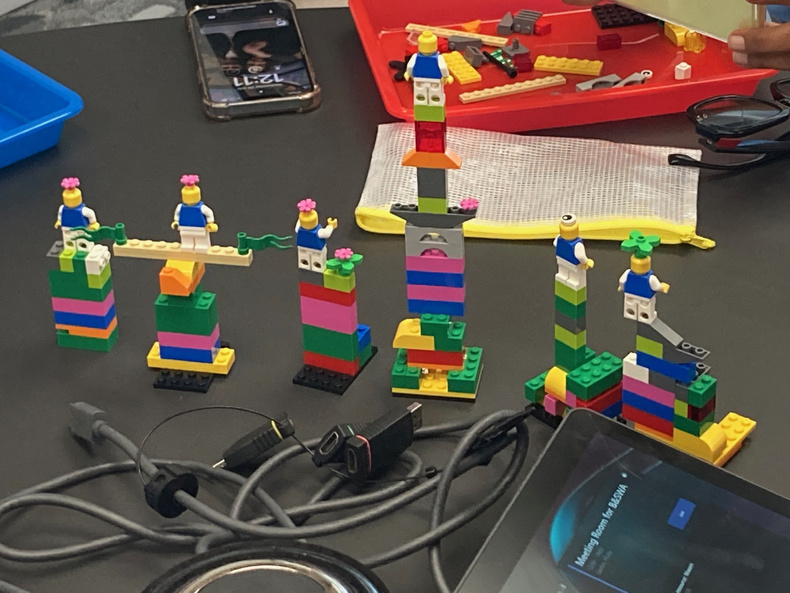
We start the workshop with everyone having a LEGO explorer pack in front of them – identical 124 pieces of LEGO, and I ask everyone the same question. “Please build me a LEGO Tower and place the minifigure somewhere on the Tower”.
Fourteen words, a pretty simple question, but look at the range of towers you can get. Some people go for height, some for stability, some sort the bricks first, some strive to use all the bricks. No two are ever the same.
For some reason, almost everyone places the minifigure on top of the tower. When I ask people what the specific instruction I gave, it was to “place the minifigure on top of the tower. “
How often have you asked a question of your team/organisation and everyone has interpreted it differently. From: “when you leave turn off all the lights and leave the key in the box,” to “check every product twice for defaults on side one and the fonts are aligned on side two. But defects slip through, the keys get lost at shift handover.
People don’t ignore your instructions or misinterpret your directions to suit themselves (generally). It is down to how our brain works.
In Daniel Kahnemans 2011 book, he introduced the concept of “thinking fast and slow”. System 1 thinking is automatic, quick and responsive. Our gut feel is how we operate the majority of the time.
Our brain works on heuristics, searching for examples of similar previous experience. It exists to help us avoid cognitive overload.
For example, when you are at the roadside about to cross the road and see a car, you wait. When you see a newborn baby, you automatically smile. Its how you can repeat your parents phone number without even thinking, but potentially not your best friends because you used it so often growing up. It is embedded in your brain.
Our brain hears a familiar pattern and instantly fills in the gaps, responding to what it expects rather than the exact words that were actually said.
An example could be: “Share the first paid job you ever had.”
System 1 hears: “Share the first job you ever had.” And people start talking about household chores, babysitting, gardening because they weren’t expecting to be asked about paid work, just work.
To ensure people really and truly listen to your question, you need to engage system two thinking. This is slower, strategic, reflective and to be frank, takes a bit of effort to engage.
To do this, you need to slow the process down.
1 Write the question – either on a flipchart, slide or give people a postit note to write it on.
2 Repeat the question – not once, twice, but three times, then…
3 Ask people (more than two) to repeat the question back to you, exactly. Keep going until you have people consistently repeating the words back to you.
4 Give people a heads up of the question importance – “I need you to listen to the exact wording of the question”
5 Pause – Ensure the room is silent before you ask the question. If there is a chatty group, walk over and stand next to them to gain their attention
6 Slow down - People hear more accurately when pace drops by 30 to 40 per cent
7 Use a prop – Print the question and hold up, people naturally look at it
In summary, plan your challenge question, the shorter the better and make sure it lands, everywhere understands what they are required to reflect on, and system two thinking is engaged to unlock creativity and innovative thinking.