Staffordshire business leaders unveil 17 key recommendations to guide devolution transition

Business leaders from Staffordshire have unveiled 17 policy recommendations designed to ensure the county’s transition to a devolved Strategic Authority delivers real benefits for local firms.
The report is a culmination of the Staffordshire Gateway Growth Panel, a research project conducted by Greater Birmingham Chambers of Commerce, in partnership with Burton and District Chamber of Commerce, Cannock Chase Chamber of Commerce, and Lichfield & Tamworth Chamber of Commerce.
It comes at a time when the English Devolution and Community Empowerment Bill is currently going through the House of Lords - and is anticipated to become law by late spring in 2026.
Regions like Staffordshire will see the establishment of a Strategic Authority, a statutory body which sits over unitary councils, to which the government will devolve the legal power and funding to control certain policy aspects for the region from inception.
Research for the report was conducted through four thematic roundtables, a survey of 153 respondents from businesses across South and East Staffordshire, and over 20 interviews and engagements with MPs, local authorities, devolution and policy specialists, and other key regional stakeholders.
Survey findings revealed that 51 per cent of businesses are not operating at full capacity and the biggest transport challenges businesses faced were parking (32 per cent), road capacity (28 per cent) and staff commuting (22 per cent).
During recruitment, 60 per cent of respondents said they could hire and retain the right people for their business. Out of those who couldn’t, 82 per cent said that there was a lack of qualified candidates and over 47 per cent said that labour costs were an issue.
In business spaces, 15 per cent of businesses cannot access premises that suit their needs, 22 per cent of businesses believe they would benefit from access to business incubation spaces, and 46 per cent of firms believe they would benefit from an innovation or science park in the region.
Access to connectivity was a key point raised with 42 per cent of businesses struggling with internet connection, whether fibre connections, mobile connections, or both.
Meanwhile, 51 per cent of firms said they have not engaged with the local authority in their area for business support in the last two years.
Of those who did engage, 56 per cent were satisfied or very satisfied with the support they received.
The survey also revealed that 58 per cent of respondents would like more funding advice, 46 per cent of businesses would like more support on skills or training, and 43 per cent of firms would like innovation support services.
The recommendations, based on the survey, centres around key themes that businesses raised during the research including preparing for a strategic authority, the business support ecosystem, the built environment, and people, process and skills.
The full list of recommendations are:
1) Establish a Key Stakeholders Forum with regular meetings to support communications and strategic input on the development of the SSA in 2026.
2) Create a ‘Statement of Intent’ that sets the direction for the SSA, bringing the various new Unitary Councils and other strategic partners together as a united front. The statement can define the parameters and vision of the new Strategic Authority, as well as setting short, medium and long-term goals.
3) Create a Business Board for the Staffordshire Region, which will hold a governance role on the SSA.
4) Under the remit of the Business Board, develop an anchor institution programme, identifying which businesses and institutions regionally have the power to drive change and to collaborate at a significant and strategic level.
5) Organise business support for Staffordshire centrally to ensure that all businesses across the SSA have the same opportunities of access, engagement, funding, and advice on finance.
6) Funding should be designed with the involvement of the business community, be available across the whole region and allow for flexibility in metrics.
7) Ensure that business support is provided by a team of SSA employees rather than contractors, with representatives for each district, town or city.
8) Implement a ‘buy local’ policy for procurement processes to give priority to local firms over outside national suppliers.
9) Create a Tourism and Hospitality Taskforce to promote the visitor economy in Staffordshire.
10) Create a Strategic Housing and Infrastructure Taskforce comprised of local authority and political representatives, as well as key stakeholders from across the region, to address regional challenges.
11) Investigate, develop and approve plans for a science and innovation park in South and East Staffordshire.
12) Investigate, develop and approve plans for business incubation spaces, where start-ups and micro businesses have the opportunity to work alongside and learn from more experienced businesses.
13) Investigate the potential for live / work spaces across the region.
14) Create an Apprenticeship Levy Transfer Scheme like the one offered by the West Midlands Combined Authority, ensuring that unspent levy can be retained in the region and used by businesses that have capacity to spend more levy.
15) Develop a skills strategy for the region, using data to identify what skills are in shortage but also to plan for the future of work. This could focus on unemployment rates, youth skills and work readiness, older workers transitioning into new careers, and shifts in the labour market due to AI adoption.
16) Publish live employment / recruitment data at a regional level to support businesses and candidates in finding the right fit.
17) Ensure that adult skills courses are designed for adults and create support for transitioning between careers.
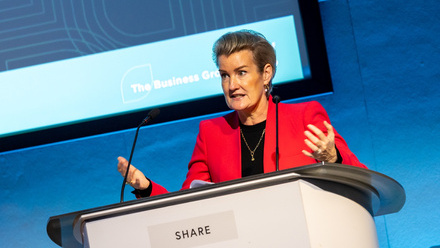
Speaking about the findings, Dr Ruth Fleet (pictured), GBCC senior policy advisor who led the project, said: “This project has been a real collaborative effort between the Chambers and businesses across South and East Staffordshire to produce an evidence-based ‘state-of-the-nation’ assessment of the opportunities and challenges facing the region right now.
“Businesses are enthusiastic about further devolution of powers and funding to a Strategic Authority and have aspirational ideas of how devolution could drive economic growth over the next ten years and beyond.
“This report won’t just sit on a shelf. GBCC will be using this as a springboard for driving action in the interim period before the establishment of a Strategic Authority, working to ensure that the voice of business remains at the heart of devolution in the region going forward.”