Council joins forces with West Midlands Police to crack down on city-centre graffiti
West Midlands Police and Birmingham City Council have joined forces to tackle the effect of graffiti in the city centre.
Enforcement action is underway with Southside district and Birmingham Colmore urging businesses and the public to play a more active role in reporting graffiti incidents, helping partners build the intelligence needed to identify offenders and speed up enforcement.
City partners are taking action, including targeted patrols and spot enforcement, but graffiti damage remains widespread.
One of the key challenges is that the vast majority of incidents are never formally reported to police, limiting the ability to link offences, spot repeat offenders and take decisive action.
While all city‑centre BIDs continue to clean and remove graffiti daily, this alone does not deter offenders.
Angela Qi Huang, business relationship manager at Southside District said: “Graffiti tagging is a scourge of the city.
Our teams remove it daily, but cleaning alone doesn’t stop it happening again. Beyond the financial cost, graffiti fuels further anti‑social behaviour and contributes to people feeling less safe.”
In 2025 alone, Birmingham Colmore and Southside District received over 500 reports of graffiti directly from businesses.
The cost of removal runs into thousands of pounds every year, with around 10% of BID cleaning budgets spent addressing graffiti across both public and private land.
Critically, it is estimated that fewer than 1 in 10 graffiti incidents are actually reported to West Midlands Police.
Without timely police reporting, offenders remain anonymous, patterns are missed, and enforcement action takes longer than it should.
All city‑centre BIDs operate with a Single Point of Contact (SPOC) at West Midlands Police for graffiti incidents, ensuring reports are logged, mapped and escalated to relevant partners. This creates a clearer operational picture but only when incidents are known about.
John‑Jo Von Johnson, head of services for Birmingham Colmore and Southside District, said: “We know police and partners are acting, but without in‑the‑moment reporting from businesses on the ground, our response remains reactive. If reporting improves, enforcement can move faster and be more targeted.”
The current focus on graffiti from West Midlands Police and Birmingham City Council reflects its growing frequency and impact, particularly on business confidence and the perception of safety in the city centre.
All city‑centre BIDs work closely with West Midlands Police, Birmingham City Council and contractors to resolve issues quickly. However, BIDs are not enforcement bodies, and their effectiveness depends on accurate, timely information being shared with police.
Dan Thomas, chief inspector for the City Centre District at West Midlands Police said: “Graffiti is a form of criminal damage and should be reported to police via 101 or online. Reports help us build intelligence and take action.
“If you have information about those responsible but don’t want to report directly, Crimestoppers is available anonymously.”
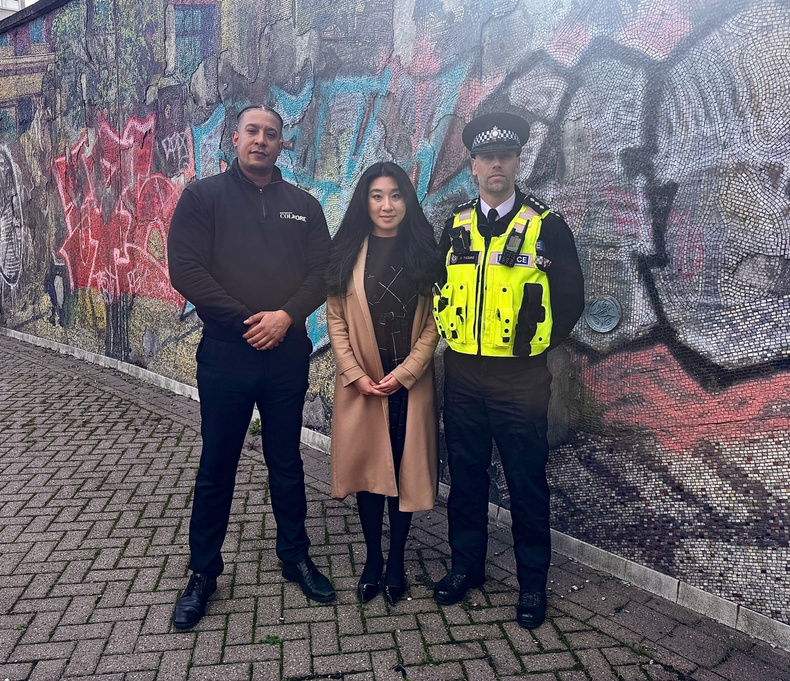
Pictured: (left to right) John-Jo Von Johnson, Angela Qi Huang and Chief Inspector Dan Thomas